
How to Build an AI Business Strategy That Actually Works

I've been there. Loading up on AI tools. Wasting money. Getting nothing done.
Then I realized the problem wasn't the tools. It was the plan. I didn't have an AI business strategy. I just had a pile of software and hope.
This guide is different. I'll show you a practical, step-by-step way to build an AI business strategy that actually moves the needle. No fluff. No hype. Just what I've learned from doing it myself and from analyzing 31 AI tools. You'll learn five steps: start with your real problem, audit your messy data, pick tools without the sales pitch, run a tiny pilot, and measure what matters.
Table of Contents
- Step 1: Start With Your Problem, Not the Hype
- Step 2: Audit Your Data , The Messy Reality
- Step 3: Pick the Right Tools (Without the Sales Pitch)
- Step 4: Run a Tiny, Ugly Pilot
- Step 5: Measure, Fail, Iterate
- FAQ
- Conclusion
Step 1: Start With Your Problem, Not the Hype
Most people start an AI business strategy by asking "What cool AI can I use?" Wrong question. Start with "What problem won't go away?"
Think about the thing that steals your time every single week. The task you dread. The bottleneck that slows everything down. That's where AI can help. Not some shiny demo you saw on Twitter.
Here is the shape of that exercise, as a worked example rather than a customer story. Spend 90 minutes talking through the daily grind and you tend to find something like this: the sales team spends three to four hours per quote. Multiply by a couple of thousand inquiries a year and quoting alone is eating thousands of hours. That number is almost never on anyone's dashboard, which is exactly why it survives. That's a problem worth solving.
An AI business strategy that actually works starts with one clear problem. Not twelve. One. Because if you try to fix everything at once, you'll fix nothing. Ask yourself: what's the one thing that, if solved, would save you the most time or money?
This approach aligns with how Wikipedia defines AI: machines that can learn, reason, and act. But you don't need a machine to do everything. You need it to do the one thing that matters most.
Key Takeaway: An AI business strategy fails when it starts with tools. Start with a single, specific, painful problem.
Bottom line: Your AI business strategy should begin with the problem that hurts the most, not the trick that looks the coolest.
Step 2: Audit Your Data , The Messy Reality
Once you have a problem, you need to look at your data. Most businesses think they have clean data. They don't. Your data is probably a mess. Spreadsheets with inconsistent formats. Emails scattered across inboxes. Notes in five different apps.
Forget trying to build a perfect dataset. Nobody has that. Instead, ask: what data do I already have that touches the problem I picked? For the quoting problem, it's historical quotes, win/loss records, and the time logs of salespeople. You probably have most of that somewhere.
Here's a practical way to audit your data without hiring a consultant: pick the three key people closest to the problem. Sit down with each for 30 minutes. Ask them: "Where do you spend the most time? What information do you wish you had right now? What takes forever to find?" Their answers will show you exactly what data you need.
In my own business, I realized my best advice came from newsletters and YouTube channels I already paid for. But that knowledge was locked inside individual tabs. I'd read a Lenny Rachitsky newsletter, forget it, and make the same mistakes later. That's why I built the system that became AI Business Advisor: A Founder's No-Fluff Guide 2026. I needed a way to access expert content on demand.
Your data doesn't have to be perfect. It just has to be accessible. An AI business strategy depends on feeding the AI the right context. If your data is scattered, your first step might be to centralize it. Not with a complex warehouse. Just a folder. A single source of truth.
70%of AI challenges come from people and process issues, not technology
That stat comes from industry research. It means your biggest problem isn't the AI. It's the mess around it. Fix the data flow first.
Pro Tip: Don't try to clean all your data at once. Just get the data for your one problem. That's enough for a pilot.
Bottom line: A successful AI business strategy starts with a real audit of the data you already have, messy as it is.
Step 3: Pick the Right Tools (Without the Sales Pitch)
Now you know your problem. You've seen your data. It's time to pick tools. This is where most people get lost. There are thousands of AI tools. Almost none of them tell you which AI model they run. Our analysis of 31 tools found that 0% disclose the model. That's a problem.
You don't need the fanciest tool. You need the tool that fits your specific workflow. The best way to pick is to match tool type to your problem.
| Tool Type | Best For | What to Check |
|---|---|---|
| CRM with AI | Sales quoting, lead scoring | Does it integrate with your email? |
| Knowledge management | Surfacing expert advice | Can it ingest newsletters and YouTube? |
| Content generation | Marketing copy, summaries | Does it respect your brand voice? |
| Automation platforms | Repetitive data tasks | Does it connect to your existing apps? |
| AI assistants | Quick reference, Q&A | Is it trained on your specific data? |
Notice I didn't name specific products. That's intentional. The right tool for you depends on your stack. But here's a general rule: if a tool can't tell you what model it uses or how it handles your data, walk away. Transparency matters.
The Salesforce guide to AI tools for small business recommends starting with one tool that does one thing well. I agree. Don't buy a suite. Buy a single hammer.
For many founders, the biggest untapped tool is not a new purchase. It's the AI they already have access to. They just need to point it at the right data. That's what Adviserry does: it turns your existing subscriptions into a searchable advisory board. I built it because nothing else on the market could ingest both newsletters and YouTube alongside my own documents. Only 71% of tools even list what content they support. Most ignore creator content entirely.
When picking tools for your AI business strategy , ask three things: Does it solve my one problem? Does it work with my existing data? Does it tell me how it uses my information? If the answer to any is no, keep looking.
Key Takeaway: The best tool for your AI business strategy is the one that fits your exact problem and integrates with your messy data, not the one with the biggest marketing budget.
Bottom line: Tool selection in an AI business strategy comes last, after the problem and data are clear.
Step 4: Run a Tiny, Ugly Pilot
This is where most strategies die. People plan for months. They build perfect systems. They never launch. Don't do that. Instead, run a tiny, ugly pilot. Pick one process. One person. One week.
Here's what a pilot looks like in practice: You have a problem with customer support tickets. Instead of buying a full AI helpdesk, you pick one channel (say, email) and one agent. You set up a simple AI tool that drafts suggested replies. The human still sends the email. You just save the time of typing from scratch.
That's ugly. It's not automated. It might even be slower at first. But you learn immediately: does the AI understand the context? Does it suggest useful answers? Where does it fail? That knowledge is gold.
I ran a pilot like this with my own newsletter digest. I was spending 30 minutes each morning scrolling through 30 newsletters. I set up a simple workflow: the AI would produce a one-paragraph summary of each newsletter and email it to me at 7am. It took 60 seconds to read. That's ugly but it worked. I learned exactly what format was useful and what wasn't.
The video above illustrates how quickly you can test an AI idea with minimal setup. Don't overthink it.
A minimum viable AI business strategy has five parts, according to Robert San Diego's framework: one problem, one team, one metric, one responsible implementation plan, and one way to build capability. That's it. Notice "one team" and "one metric". That's what a pilot gives you.
"The hardest part of creating a minimum viable AI strategy isn't figuring out what to include. It's having the discipline to exclude everything else." , Robert San Diego

Once your pilot runs, you'll have real data. Did it save time? Did it reduce errors? Did it improve something concrete? If yes, scale it. If no, change approach. Either way, you win.
Pro Tip: Set a timer. Give yourself two weeks to run the pilot. No more. If it's not working by then, kill it and try something else.
Bottom line: An AI business strategy that stays on paper is worthless. Run a tiny, ugly pilot to test your assumptions with real work.
Step 5: Measure, Fail, Iterate
You ran your pilot. Now what? Most people either abandon the AI or try to scale it immediately. Both mistakes. The right move is to measure honestly.
Pick one metric. Just one. For the quoting problem, it was time per quote. Before the AI, the average was 3 hours. After the pilot, it dropped to 2 hours. That's progress. But don't stop there. Ask why it's 2 hours and not 1.5. Dig into the failures.
Statistics show that over 80% of AI projects fail to reach production. That's not because AI is bad. It's because teams didn't iterate. They built a big system, launched it, and when it didn't work perfectly, they gave up. The right approach is tiny cycles of measure-fail-iterate.
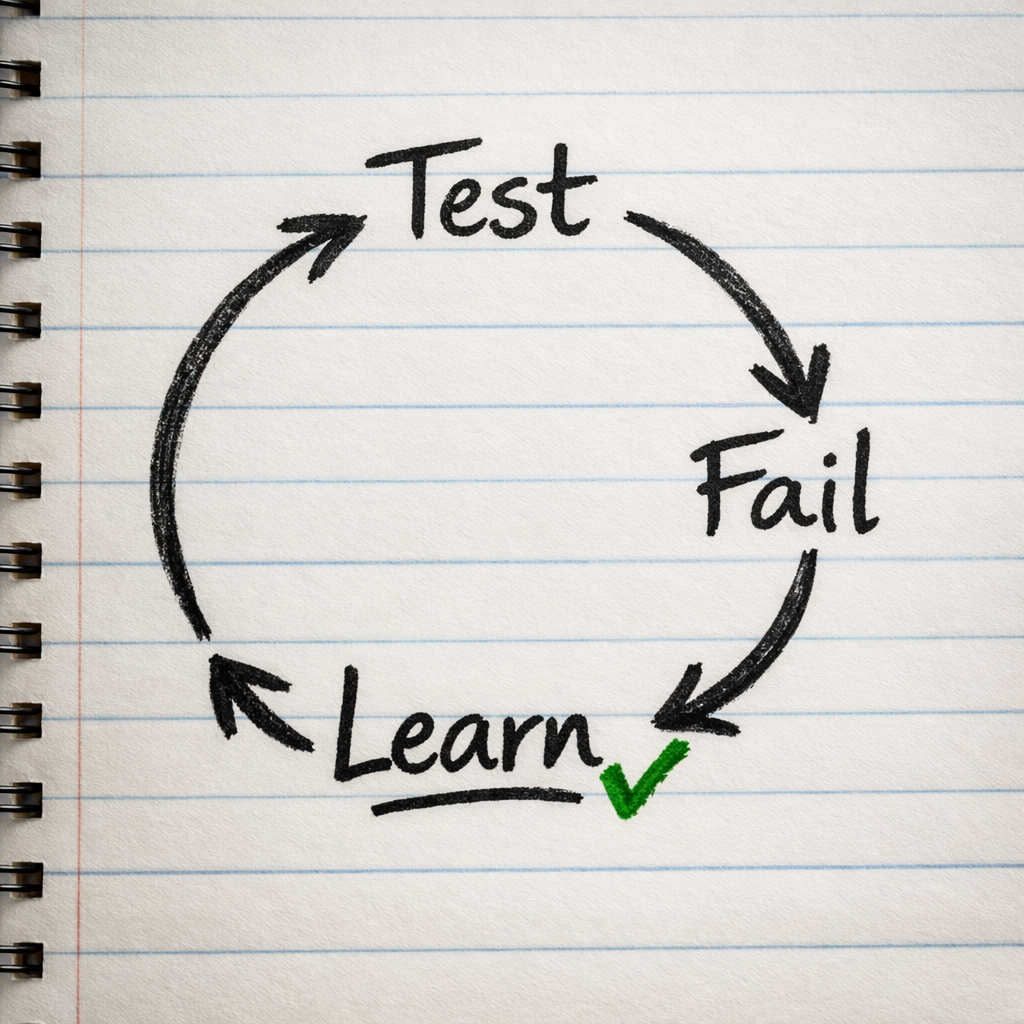
In my own experience with Adviserry, the first version was terrible. It could only handle email newsletters. Users wanted YouTube channels too. I added that. Then they wanted document uploads. Added that. The product improved because I measured what users actually asked for, not what I guessed.
Your AI business strategy needs regular checkpoints. Every two weeks, review the metric. Is it moving in the right direction? If not, change something. Maybe the tool is wrong. Maybe the data needs cleaning. Maybe the process doesn't match reality. The key is to keep measuring.
Continuing the same worked example: run three iterations on a quoting process and the realistic outcome is not a rebuilt system, it is a shorter loop. Most of the gain comes from adjusting the prompts and pointing at better data sources rather than from buying a tool. Small wins compound.
Key Takeaway: An AI business strategy that doesn't measure and iterate is just a hope dressed up in a plan.
Bottom line: Measure one metric, expect failure, and iterate fast. That's how an AI business strategy becomes real.
FAQ
What is an AI business strategy?
An AI business strategy is a plan for using artificial intelligence to solve specific business problems, not just to adopt technology. It starts with identifying a pain point, auditing the relevant data, selecting the right tools, running a small pilot, and measuring results. The goal is alignment with overall business objectives, not chasing trends. A good strategy focuses on one problem at a time and iterates based on real outcomes.
How do I start building an AI business strategy if I have no technical team?
You don't need a data science department. Start with a single problem you understand deeply. Use no-code or low-code AI tools that integrate with your existing stack. Run a pilot with just one person. Many AI assistants now work like a smart copywriter or analyst. The most important thing is to begin with the problem, not the technology. You can always hire help later.
How long does it take to see results from an AI business strategy?
Results can show in as little as two weeks with a focused pilot. For example, automating a manual reporting task might save hours per week immediately. But full transformation takes several rounds of iteration. Expect 3-6 months to fine-tune processes and get consistent measurable improvement. The key is setting realistic expectations and committing to continuous measurement.
What are the biggest mistakes in building an AI business strategy?
The top mistake is starting with tools instead of problems. People buy an AI subscription and then look for something to do with it. Other common mistakes include trying to solve everything at once, ignoring data quality, not involving the people who do the actual work, and skipping the pilot phase. Most failures are not technical, they are about process and alignment.
How do I measure success of my AI business strategy?
Pick one concrete metric tied to your original problem. For example, time saved per task, reduction in errors, increase in leads handled per day, or customer satisfaction score. Measure it before and after the pilot. Track it weekly. If the metric improves, you're on the right track. If it doesn't, iterate. Avoid vague goals like "improve efficiency" without a specific number.
Should I build a custom AI tool or use an off-the-shelf product?
For most small businesses, off-the-shelf products work best. Custom AI requires significant data, expertise, and maintenance. Start with a tool that solves your specific problem and integrates with your existing stack. Build custom only if no existing product meets your needs and you have the resources to maintain it. The cost of custom often outweighs the benefit at early stages.
How do I ensure my AI business strategy is ethical and compliant?
Start by being transparent with your team and customers about how you use AI. Avoid feeding sensitive data into public AI models. Choose tools that offer clear data privacy policies and let you control where data is stored. Regularly audit outputs for bias or errors. As regulations like the EU AI Act evolve, keep informed about requirements for high-risk uses. An ethical strategy builds trust and avoids legal pitfalls.
Can one person implement an AI business strategy alone?
Absolutely. A solo founder or a small team can absolutely build and execute an AI business strategy. The key is to limit scope to a single problem and use simple, off-the-shelf tools. The modern AI landscape is accessible with no-code interfaces. You don't need a team of engineers. You just need discipline to focus, measure, and iterate. In fact, small teams often move faster than large ones.
Conclusion
Building an AI business strategy that actually works isn't complicated. It's just a lot of small, careful steps. Start with a specific problem. Look at your messy data honestly. Pick one tool that fits. Run a quick, ugly test. Measure one number. Then do it again.
The companies that succeed with AI aren't the ones with the biggest budgets or the fanciest algorithms. They're the ones that treat AI as a process, not a project. They iterate. They fail fast. They keep going.
Your AI business strategy should be a living thing. Update it as you learn. Don't be afraid to kill a pilot that isn't working. Focus on the metric that matters. And remember: you don't need to be an expert. You just need to start.
If you want a simpler way to access expert advice from your newsletters and YouTube subscriptions, check out Cheaper Than Business Coach AI: A Founder's Guide. It's a tool I built because I needed it. It might help you too.
Key Takeaway: The best AI business strategy is the one you actually execute, measure, and improve.