
How to Launch an AI Startup in 2026: A No-Fluff Guide
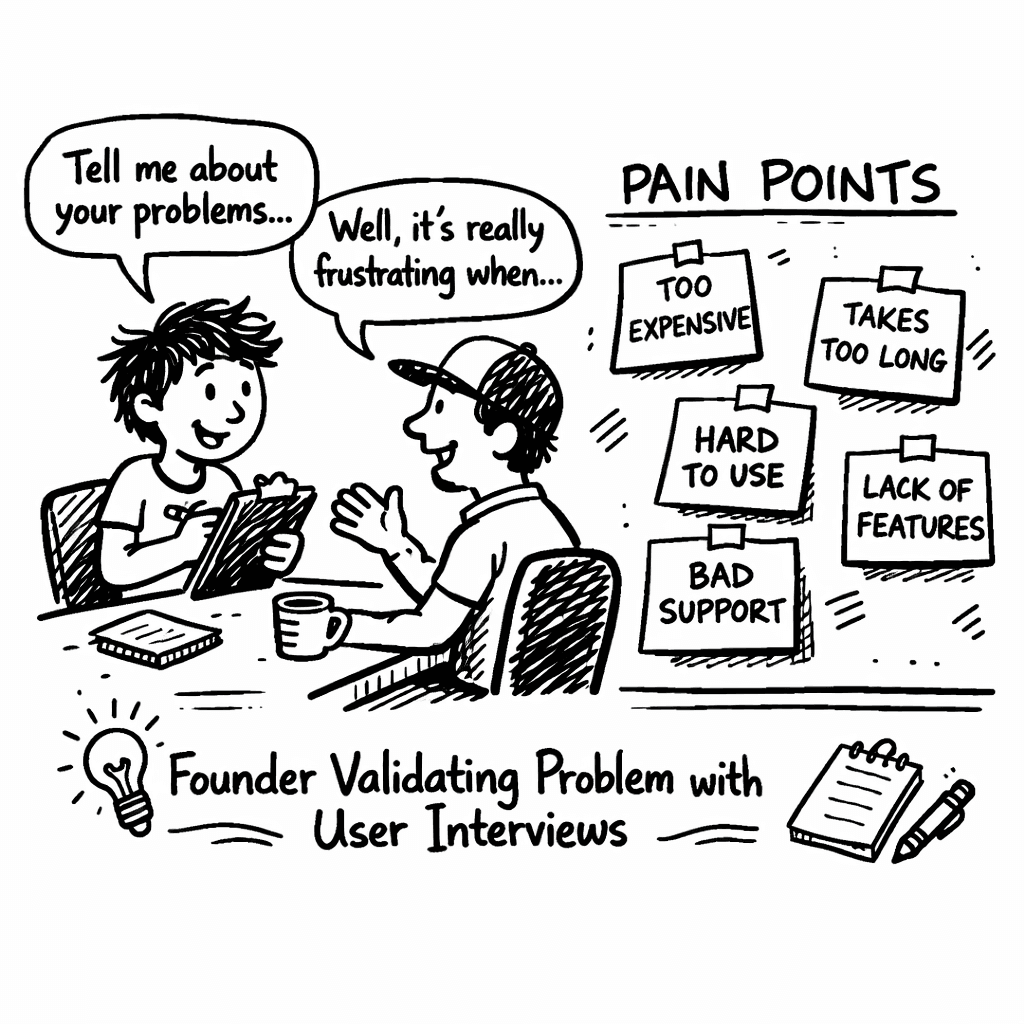
Launching an AI startup in 2026 is mostly the same as launching any startup: find a problem people already pay to solve, ship the smallest thing that solves it, and talk to users before you build more. The AI-specific part is narrow, and it is mostly about cost and defensibility. Model access is a commodity now, so being an AI company is not a strategy.
What follows is the sequence: validate the problem, prototype without engineers, get the first users, close the feedback loop, and charge early.
Table of Contents
- Step 1: Nail the Problem (Don’t Fall in Love with the Tech)
- Step 2: Build a Prototype Without Writing Code
- Step 3: Get Your First 10 Users (The Hard, Honest Way)
- Step 4: Iterate Based on Feedback (Without Drowning in Requests)
- Step 5: Monetize Early and Automate Yourself
- Frequently Asked Questions
- Conclusion
Step 1: Nail the Problem (Don’t Fall in Love with the Tech)
Most AI founders start with a shiny model and end up with a dead product. A 2025 MIT study showed that only about 5 % of generative-AI pilots ever hit rapid revenue growth. The rest stall because they’re solving the wrong problem or treating AI as a one-off experiment.
Here’s what you need to do:
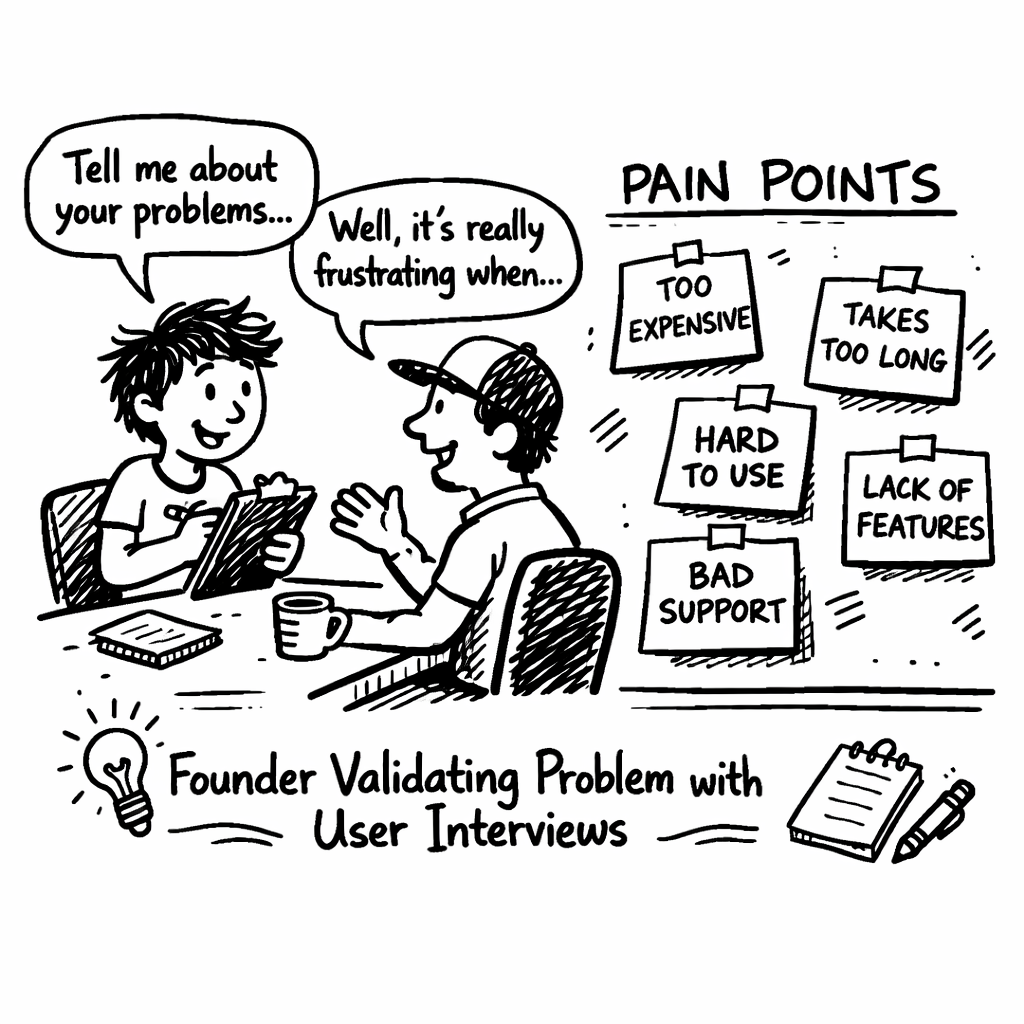
- Talk to real users. Ask what keeps them up at night.
- Write down the pain in one sentence. If you can’t, you’re still vague.
- Score the pain on a 1-10 scale. Aim for 8+ before you code.
Imagine you’re building an AI board for founders. Instead of assuming they need “more data”, ask them: “What’s the biggest decision you make without expert advice?” An AI advisor can provide on-demand answers, unlike scheduled coaching. If they answer “pricing strategy”, that’s your north star.
Pro Tip: Run a 15-minute interview with five founders and look for recurring verbs like “guess”, “waste”, or “delay”. Those verbs point to unmet needs.
Why does this matter? Because data shows that startups that focus on a single, sharp pain point are twice as likely to reach product-market fit ( LinkedIn research).
Don’t fall for the hype of “AI can do anything”. Pick a concrete workflow , - for example, turning newsletters into searchable advice , - and test it.
Key Takeaway: Validate the problem with real users before you write any code.
Bottom line: A nailed problem saves you months of wasted engineering.
Step 2: Build a Prototype Without Writing Code
Once the problem is crystal clear, you need something tangible fast. No-code platforms let you spin up an MVP in a day.
Start with a simple workflow:
- Collect source content (newsletters, YouTube videos) using an RSS feed or a YouTube API.
- Feed the text into a hosted LLM (OpenAI’s API works well). OpenAI’s official API docs give you a quick start guide.
- Wrap the LLM in a chat UI , - tools like Retool or Bubble make this drag-and-drop.
Here’s a quick decision matrix to help you pick a no-code stack:
| Feature | Bubble | Retool | Adviserry (built-in) |
|---|---|---|---|
| API integration | ✔️ | ✔️ | ✔️ (auto-ingest newsletters) |
| Custom UI | ✔️ | ⚡ | ✔️ (AI chat UI) |
| Gmail push | ❌ | ❌ | ✔️ (native Gmail integration) |
Notice how Adviserry already does the heavy lifting of ingestion and Gmail push. That’s why it beats most competitors that require manual Zapier connections.
57%of AI advisory tools lack end-to-end automation
Build the prototype, then share the link with the five users you interviewed in Step 1. Ask them to ask any question they would normally ask a human advisor.
Pro Tip: Set up a simple Google Form to capture their questions and satisfaction scores in one place.
Iterate on the UI based on that feedback , - you don’t need a perfect design, just something that works.
Key Takeaway: No-code gets you from idea to testable product in hours, not weeks.
Bottom line: A functional prototype is better than a perfect mockup.
Step 3: Get Your First 10 Users (The Hard, Honest Way)
Cold outreach is the fastest path to your first ten users. It’s raw, it’s personal, and it forces you to own your story.
Start by defining an Ideal Customer Profile (ICP). For an AI advisory board, your ICP might be “early-stage SaaS founders who subscribe to at least three industry newsletters”.
Build a list:
- Use LinkedIn Sales Navigator to filter by title (Founder, CEO) and company size (1-20).
- Export the list to a CSV.
- Enrich it with verified emails using a tool like Wiza Prospect (mentioned on HubSpot).
Now craft a personalized email. The research shows that personalization can boost response rates from 21 % to over 30 %.
Example template:
"Subject: Quick question for Founder Name , can we help you cut pricing guesswork in half? Hi First Name , I noticed you recently wrote about pricing on your blog. My AI board pulls in the latest insights from top pricing experts and answers questions right in Gmail. Would you be open to a 15-minute call to see if it saves you time? Thanks, Adam"
Send the email early in the morning (6-9 a.m. PST) , research says that timing adds 23 % more opens.
Follow up once after three days. If they still don’t reply, move on. Keep the process lean.
Pro Tip: Track every touch in a simple Airtable base so you never double-email the same prospect.
When a prospect says yes, give them a short sandbox link to your no-code prototype. Ask them to try a real question, like “What should I price my SaaS at $10-$20 ARR?” and watch the AI answer.
Early adopters love feeling like they’re shaping the product. Capture their feedback in a shared Google Sheet.
Bottom line: Personalized cold outreach beats generic blasts every time.
Step 4: Iterate Based on Feedback (Without Drowning in Requests)
Once you have ten users, feedback will pour in. The trick is to sort the noise.
Use a prioritization framework. The Effort-Impact Matrix is simple and works for solo founders.
- High impact, low effort: Quick UI tweaks, clearer error messages.
- High impact, high effort: Adding new data sources (e.g., podcasts).
- Low impact, low effort: Changing button colors.
- Low impact, high effort: Re-building the entire backend.
Plot each request on a quick whiteboard. Focus on the “quick wins”. Those give you visible progress without burning time.
Another option is the RICE score ( Airwallex’s guide explains it well). Calculate Reach × Impact × Confidence ÷ Effort for each feature.
68%of B2B startups credit a clear ICP for outreach success
When you see a pattern , - say users keep asking for “investment round advice” , - turn that into a new board in Adviserry. The platform already lets you add new content sources with a click.
Pro Tip: Schedule a 30-minute “feedback sprint” every two weeks. Invite all active users, present changes, and collect votes on the next priority.
Remember to say thank you. A short “Your feedback helped us add X feature” email boosts loyalty.
Key Takeaway: Structured prioritization turns endless requests into a clear roadmap.
Bottom line: Focus on high-impact, low-effort tweaks to keep momentum.
Step 5: Monetize Early and Automate Yourself
Most founders wait months to charge. That’s a mistake. You can start taking money as soon as ten users see value.
Pick a simple pricing model: $49 per month for “up to 5 boards” or $99 for unlimited. Use Stripe’s checkout page , it’s a few lines of code or a no-code embed.
Automation is key. Set up a Zap that does the following:
- When a new subscriber pays, add them to a “Customers” Google Sheet.
- Send a welcome email with a link to their first board.
- Every week, trigger Adviserry’s daily digest to land in their inbox.
This flow means you spend zero time on billing after the first setup.
Why charge early? The same MIT report cited earlier notes that startups that monetize early are 1.8× more likely to survive past year 1.
1.8×higher survival when you charge from day one
Don’t forget to test price sensitivity. Offer a 14-day free trial to the first ten users, then ask them how much they’d pay to keep the service.
Pro Tip: Use Stripe’s “Coupon” feature to give early-adopter discounts that automatically expire after the trial.
When you need to scale, consider moving from Zapier to a serverless function (AWS Lambda) , but only after you’ve validated demand.
Key Takeaway: Early revenue and automation free you to focus on product, not paperwork.
Bottom line: Monetize fast, automate the money flow, and keep building.

Frequently Asked Questions
What’s the smallest viable AI feature I can ship?
Start with a single-question answer bot that pulls from one newsletter source. The AI reads the latest issue, indexes it, and answers a user’s query in Gmail. This core loop proves value before you add more boards or data sources. It also keeps costs low because you only pay for the API calls you use.
How do I choose between a no-code tool and building code?
If you can get a functional prototype out in a week, go no-code. Build code only when you hit a hard limit , - like needing custom scaling, complex data pipelines, or a proprietary model that no-code platforms don’t support.
Do I need a lot of data to train my AI?
No. For advisory boards, you’re not training a model; you’re prompting a pre-trained LLM with fresh content. The real work is in cleaning and curating the source material , - newsletters, videos, or docs , - not in massive datasets.
What legal concerns should I watch for?
Make sure you have the right to ingest the newsletters and YouTube content you’re using. Most creators allow personal use, but for commercial resale you need permission. Also, add a disclaimer that AI answers are for guidance, not legal advice.
How can I keep users engaged after the first month?
Send a weekly “Insight Digest” that highlights the most asked questions and top answers. Use Adviserry’s built-in Gmail integration to land the digest right where founders already look.
Is it worth applying for accelerator funding early?
Accelerators can give you cash and mentorship, but they also take equity. If you already have ten paying users and a clear roadmap, you can bootstrap longer and keep more ownership. Apply only if the program’s network aligns with your target market.
What metrics should I track?
Track Monthly Recurring Revenue (MRR), churn rate, and the number of AI queries per user. Also watch “time to first answer” , a fast response builds trust and boosts usage.
Can I expand beyond newsletters?
Absolutely. Adviserry already supports YouTube channel ingestion. Adding podcasts or PDFs is a matter of hooking the source into the same indexing pipeline.
Do you need to train your own model to start an AI startup?
Almost never, and doing it early is a common way to spend a year building something a hosted model already does. Start on an API. Train or fine-tune only once you have a dataset or a workflow no competitor can get, which is a position you reach through users rather than before them.
What is defensible about an AI startup if anyone can call the same model?
Not the model. The defensible parts are the data you accumulate by operating, the workflow you own end to end, and the switching cost of being embedded in how someone works. If your product is a prompt in a wrapper, assume it is copyable in a weekend, because it is.
How much should an AI startup budget for model costs?
Less than most founders fear at first, and more than they plan for at scale. Early on, inference for a small user base usually costs less than a single contractor. The number that matters is cost per active user per month; measure it from your first paying customer, because it decides whether your pricing works before you have any leverage to change it.
Conclusion
Launching an AI startup in 2026 isn’t about building the biggest model. It’s about solving a real founder pain, proving it with a no-code MVP, getting ten paying users, and iterating with a clear roadmap. Tools like Adviserry make the heavy lifting of content ingestion and Gmail delivery painless, so you can focus on the advice that matters.
If you follow the steps above, you’ll be able to validate, prototype, acquire, iterate, and monetize without drowning in tech debt. Keep the feedback loop tight, automate the boring parts, and let the AI do the heavy lifting. The next AI-powered advisory board will be yours , just start building it today.
Key Takeaway: Ten real users give you data, credibility, and the first revenue stream.