The Creator Economy's Hidden Value: Your Subscriptions Are a Goldmine You're Not Mining

The Creator Economy's Hidden Value: Your Subscriptions Are a Goldmine You're Not Mining
There's a weird disconnect in how we think about content subscriptions.
We subscribe to newsletters because we believe the creator has valuable expertise. We follow YouTube channels because we think their content will make us better at our jobs. We download podcast episodes because someone smart is sharing lessons we want to learn.
Then we consume maybe 20% of it, retain maybe 10% of what we consume, and let the rest rot in our inboxes and feeds. We're sitting on a goldmine of expert knowledge and we're barely scratching the surface.
This isn't a discipline problem. It's an access problem. And it's one the creator economy hasn't solved yet.
The value your subscriptions actually contain.
Think about this: if you subscribe to 10 quality newsletters and each publishes weekly, that's 520 issues per year. Each issue contains distilled expertise from someone who's spent years or decades in their field. Frameworks, case studies, data, specific tactics, lessons learned.
Collectively, your newsletter subscriptions might contain more practical business knowledge than a Harvard MBA program. I'm not exaggerating. The quality of what Lenny Rachitsky publishes about product management, what Alex Hormozi shares about growth, what Patrick Campbell teaches about pricing, this is world-class education delivered to your inbox for free or cheap.
But there's no syllabus. No review sessions. No exams. No way to search across issues. No way to ask "what did my subscriptions collectively say about this topic?" The knowledge arrives, sits in your inbox, and eventually disappears under newer emails.
Creators are leaving value on the table too.
This isn't just a consumer problem. Creators spend enormous effort producing content that gets read once and forgotten. A newsletter issue that took 10 hours to write gets skimmed in 3 minutes and never referenced again. A YouTube video that took a week to produce gets watched once and maybe liked.
The long-tail value of that content, the ability to search it, reference it, cross-reference it with other creators, and apply it to specific situations months or years later, is completely unrealized.
Some creators have started addressing this. Substack lets you search a creator's archive. YouTube has transcripts. Some creators build courses from their best content. But these are all isolated, single-creator solutions. There's no way for a subscriber to search across all their subscriptions at once.
The subscription goldmine framework.
Here's how I think about the untapped value:
Layer 1 is consumption value: reading or listening to the content as it arrives. This is what most people do (when they do anything at all). It's the surface layer.
Layer 2 is retention value: actually remembering and being able to recall the key insights later. Tools like Readwise help here with highlights and spaced repetition.
Layer 3 is synthesis value: connecting ideas across multiple creators and finding patterns. "Three of my marketing sources all recommend the same approach to pricing" is way more convincing than reading it from one person.
Layer 4 is application value: taking the knowledge and applying it to your specific situation. "Based on what Hormozi, Lenny, and Patrick Campbell say about pricing, here's what makes sense for my B2B SaaS at my stage."
Most people operate entirely at Layer 1. Some make it to Layer 2. Almost nobody reaches Layers 3 and 4 manually, because cross-referencing and applying knowledge from dozens of sources is incredibly time-consuming.
AI makes Layers 3 and 4 accessible.
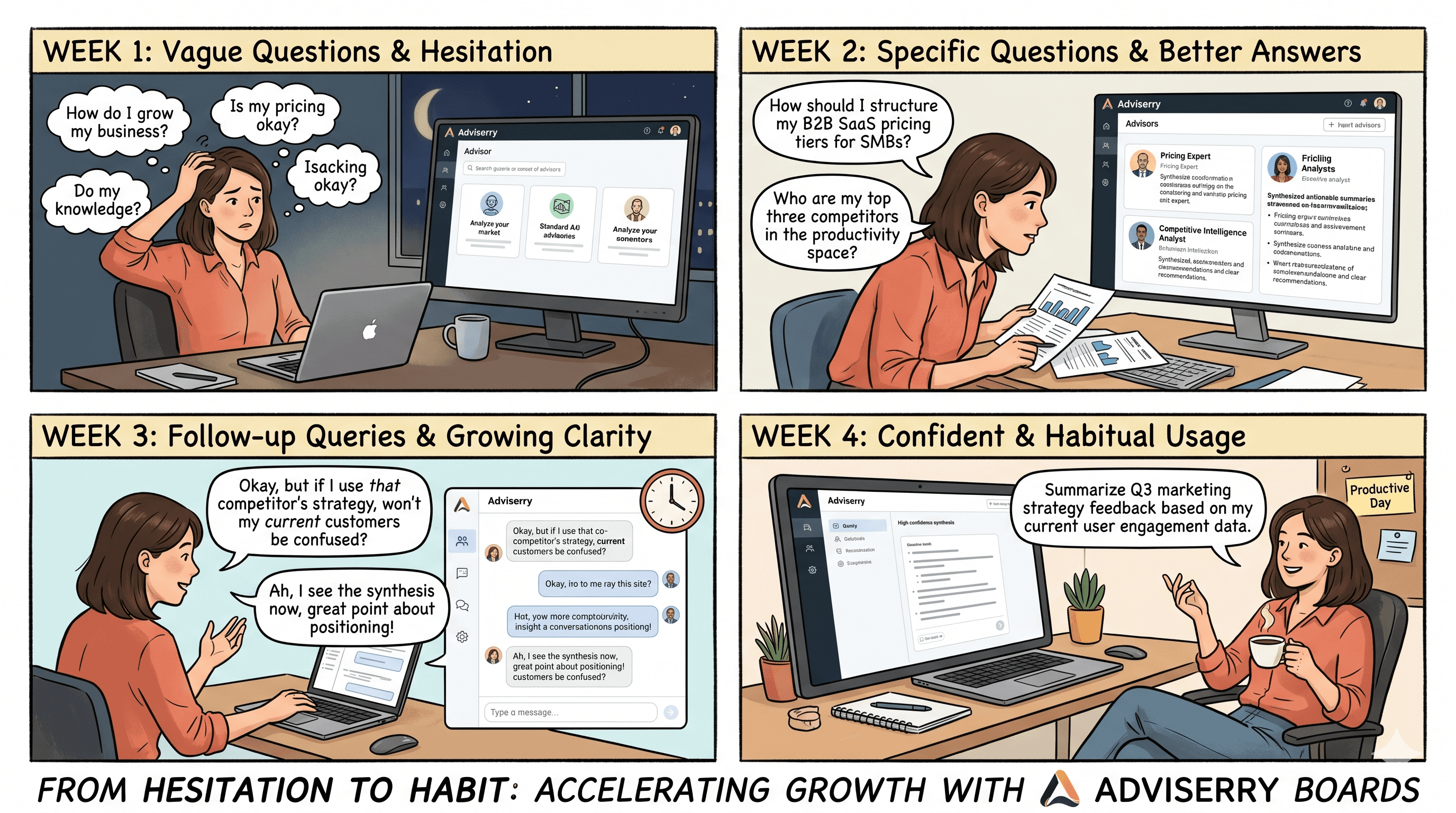
This is why I built Adviserry (so yeah, I'm biased). The core thesis: your subscriptions already contain everything you need. The gap is purely about access and synthesis.
When all your newsletters and YouTube subscriptions are in one searchable, chat-enabled system, suddenly Layers 3 and 4 become trivial. "What do my marketing sources agree on about content strategy?" takes 30 seconds. "Apply my pricing sources' frameworks to my specific product" takes a minute.
The knowledge was always there. You were always paying for it. Now you can actually use it.
What this means for knowledge workers.
The competitive advantage in the next few years won't be who consumes the most content. It'll be who extracts the most value from the content they already consume.
Two founders can subscribe to the exact same newsletters. One reads them and forgets. The other builds a system that makes the knowledge permanently accessible and queryable. Six months later, one is making decisions from memory and gut feel. The other is making decisions informed by a searchable archive of expert advice.
Same subscriptions. Same cost. Completely different outcomes.
Your subscriptions are the goldmine. The question is whether you're mining them or just watching the gold flow past.
Start mining.