Podcast Listeners Retain 10%. Here Is How to Fix That
Podcast Listeners Retain 10% of What They Hear. Here's How to Fix That
I did the math recently and it's a little depressing. I listen to podcasts about 5 hours per week. That's roughly 260 hours per year of business advice, founder stories, product frameworks, and growth strategies flowing directly into my ears.
If I retain 10% of that (which research on audio learning suggests is roughly the ceiling for passive listening), I'm getting 26 hours of value from 260 hours of input. If I'm honest with myself, 10% might be generous. Some weeks I listen to podcasts while doing dishes and retain approximately nothing.
I'm not going to stop listening to podcasts. They're too convenient. They fill dead time. They expose me to ideas I wouldn't encounter otherwise. And the good ones are genuinely great.
But I am going to stop pretending that listening equals learning. Because it doesn't. Not even close.
Why audio is uniquely bad for retention.
Text lets you skim, reread, highlight, and review. You control the pace. If something is confusing, you read it again. If something is boring, you skip ahead. Your eyes can jump back to a key paragraph instantly.
Audio gives you none of that. It moves at one speed (okay, 1.5x for the impatient among us). If you miss something, you have to scrub back, guess where it was, and re-listen. If your attention wanders for 30 seconds (which happens constantly during passive listening), that content is gone. You'll never know you missed it.
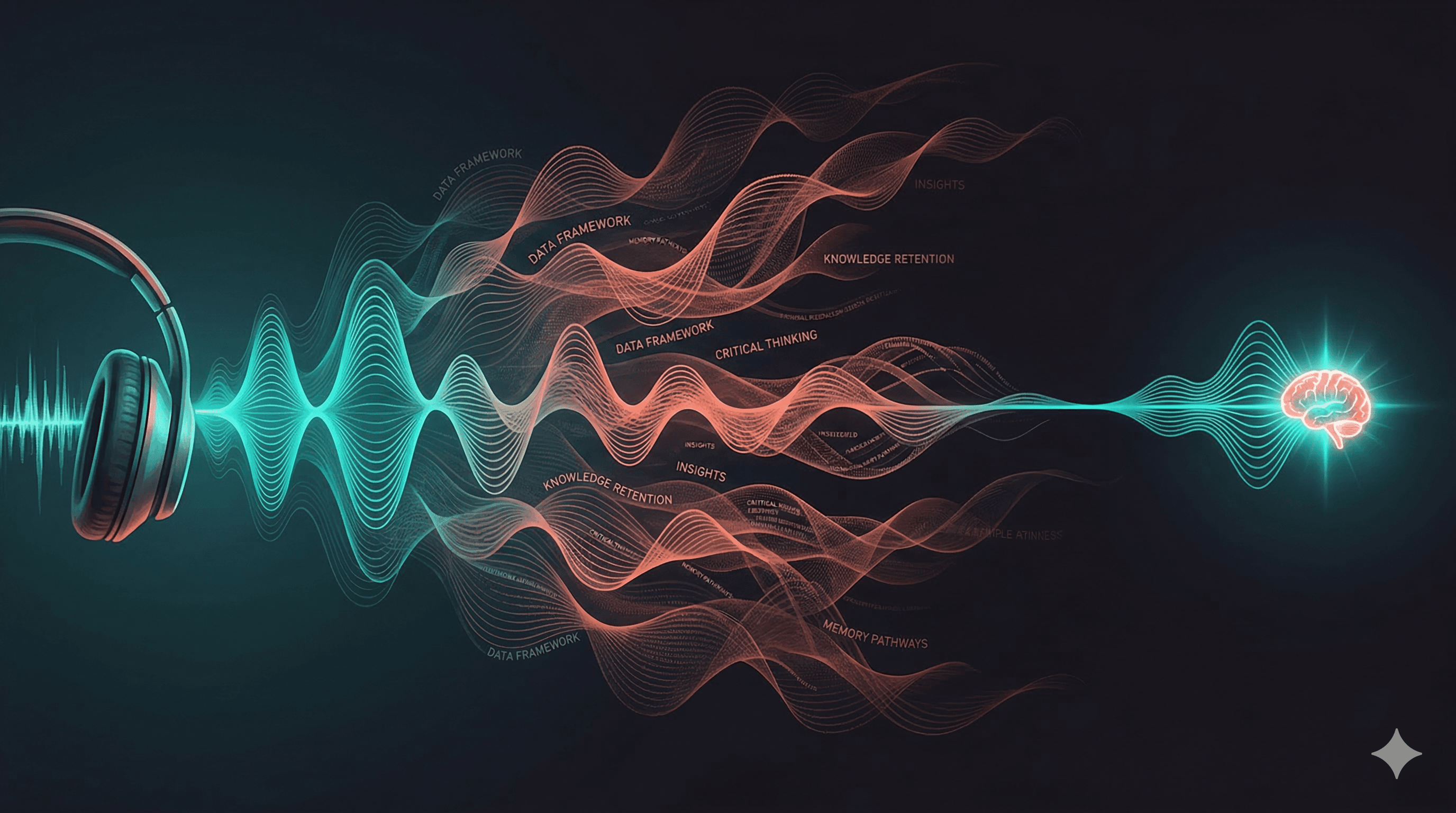
The result: podcast listening feels productive because you're absorbing new ideas. But the actual retention is terrible because the format gives your brain no tools for encoding information into long-term memory.
The three approaches that actually help:
Turn audio into text, then treat it like a document. This is the approach that works best for me. Most podcast-style content on YouTube already has transcripts. Tools like Otter.ai can transcribe live audio. Once you have text, you can search it, highlight it, and ask questions about it. Adviserry does this automatically for YouTube-first podcasts: it fetches transcripts, summarizes each episode, and makes everything searchable by topic. I built Adviserry (so yeah, I'm biased), and the ability to ask "What did that Lenny episode say about retention metrics?" instead of scrubbing through 90 minutes of audio was the original problem that got me started.
Capture moments while you're listening. Apps like Snipd detect key points in podcast episodes and let you save them with a tap. Each snip saves the transcript, a summary, and the audio clip. It requires you to be actively listening (not just having audio on in the background), but it's way more efficient than pausing to take manual notes. Export your snips to Readwise or Obsidian for review later.
Use spaced repetition on what you do capture. Whatever method you use to capture podcast insights (notes, snips, highlights from transcripts), feeding them into a spaced repetition system like Readwise dramatically improves long-term retention. Being reminded of a key concept three days later, then a week later, then a month later moves it from "something I heard once" to "something I actually know."
The passive listening problem.
Here's the uncomfortable truth: a lot of my podcast listening is passive. Background audio while cooking, commuting, or doing chores. And passive listening retains almost nothing.
I used to feel good about this. "I listened to four podcast episodes today, I'm learning so much!" No. I was entertained for four hours. Learning requires engagement, and engagement requires attention, and attention is exactly what's divided when you're simultaneously listening to a podcast and making dinner.
I'm not going to stop passive listening. It's one of life's small pleasures. But I've stopped counting it as "learning." If I want to actually learn from a podcast episode, I either listen to it actively (sitting down, focused, maybe with Snipd open) or I add the YouTube version to an Adviserry panel and interact with the transcript later.
The fix isn't listening more carefully.
Just like the fix for newsletter overload isn't "read more newsletters," the fix for podcast retention isn't "listen more carefully." It's building systems that capture the value regardless of how carefully you listened.
The best podcast learning system I've found: subscribe to the YouTube versions of my favorite podcasts, add those channels to Adviserry, let the transcripts get processed automatically, and query the content when I need it. I still listen passively for enjoyment, but when I need to recall what someone said, I have a searchable archive ready.
260 hours of podcasts per year. Even if I only use 10% of that archive, it's a far better 10% when I can choose which 10% to access in the moment I need it, rather than leaving it up to whatever my brain happened to retain from the last episode I half-listened to.
Build the system. Enjoy the podcasts. Query when you need to. That's the whole strategy.