Why Podcasts and YouTube Aren't Enough: The Missing Layer Between Consuming and Applying
Why Podcasts and YouTube Aren't Enough: The Missing Layer Between Consuming and Applying
Quick question. Off the top of your head: what did Alex Hormozi say about how to structure pricing tiers for a service business? Not the general principle. The specific framework. From which episode or post?
If you can't answer that in ten seconds, you're in good company.
I've listened to probably 400 hours of founder podcasts. I've watched My First Million more times than is dignified to admit. I subscribe to Lenny's Newsletter, the Strategy Letter, Not Boring, and about twelve others I've lost track of. I am, by most definitions, an information-saturated person who is deeply committed to learning from people who are smarter than me.
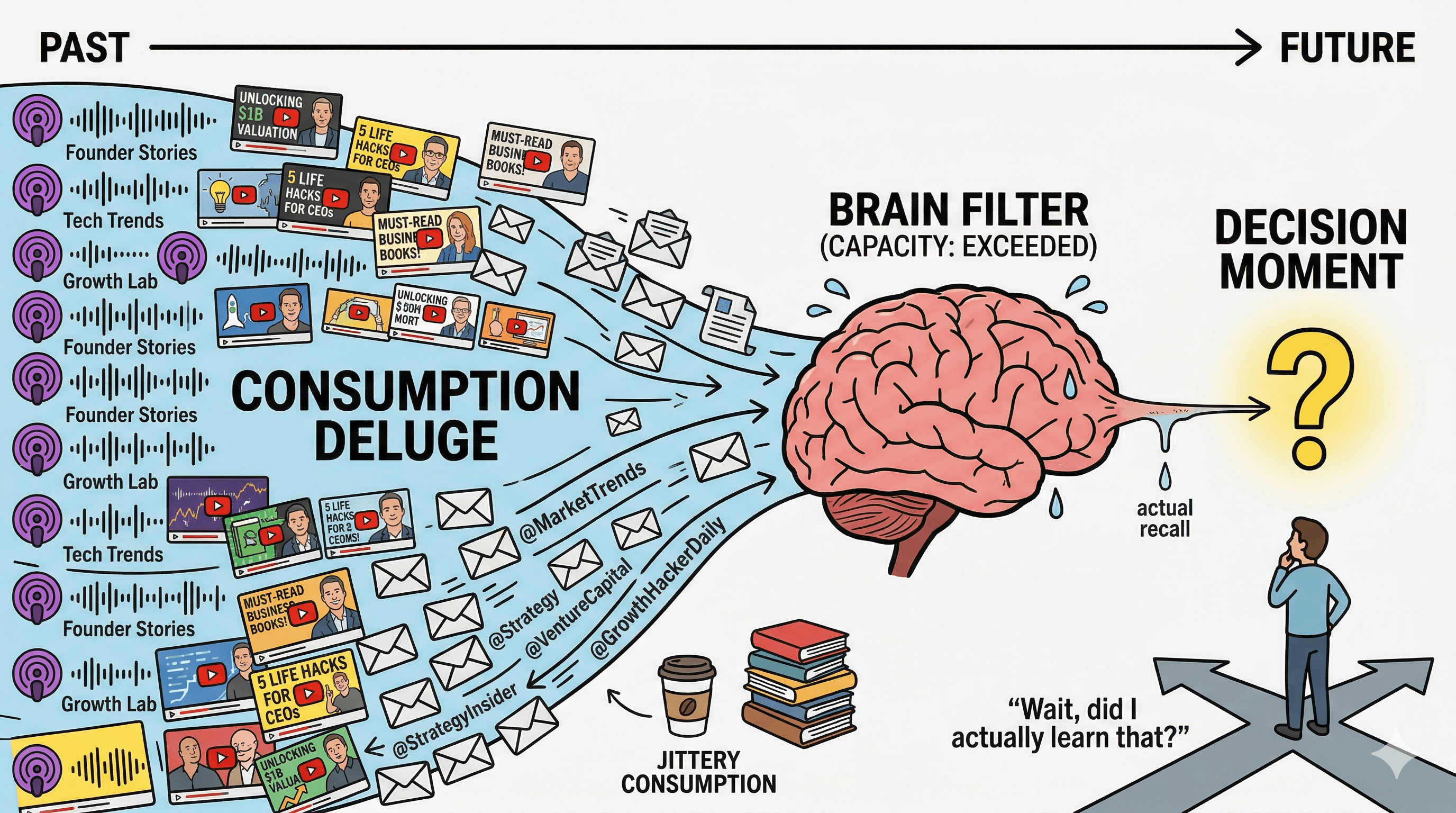
And yet, when I'm staring at an actual decision (should I hire or outsource this function? Should I run a cohort model or go self-serve?), I can't recall the specific insights I need, from the specific experts I trust, in a form I can actually use.
The retention problem nobody talks about.
It's not that the content is bad. Most of it is excellent. The problem is the retrieval mechanism. You listened to a podcast episode three months ago. The insight you need was in the middle of a 90-minute conversation about something slightly adjacent to your actual problem. You'd need to remember which episode, navigate to the right timestamp, and then translate a half-remembered principle into a specific recommendation for your situation.
Nobody does this. You just go with your gut and hope it aligns with something you heard once.
The gap is not between smart founders and dumb founders. It's between consuming information and being able to access it when you need it: in the context of a specific decision, right now.
Passive intake vs. on-demand expertise.
Podcasts and YouTube are broadcast media. They're designed to be interesting to a large audience at the moment of consumption. They're not designed to be queryable, contextual, or tied to your specific situation. A great podcast episode is like a lecture at a conference. You learn something, you feel inspired, and three days later you remember the vibe more than the content.
An AI advisory board built from your content sources works differently. Instead of consuming Hormozi and hoping you remember the right part later, you're able to ask: "What has Hormozi said about this specifically, in the context of a business like mine?" And you get an answer. Sourced. Specific. Now.
The creators you follow are already your advisors. You just can't access them.
This is the insight that originally pushed me toward building Adviserry. The people I follow (the ones I've subscribed to, whose books I've bought, whose frameworks I've internalized) are already my advisory board in a loose sense. I've curated them because I trust their thinking. The problem is I can only access their thinking through the consumption mechanism they've chosen (the podcast, the newsletter, the video) at the time they chose to publish it.
What if you could query their collective intelligence instead? What if the 200 hours you've already invested in consuming their content could be turned into something you could actually talk to?
That's the missing layer. And it's closer than most people realize.
Keep Reading:
- Podcast Listeners Retain 10% of What They Hear: the audio retention problem
- 5 Best AI Tools for Turning Podcasts Into Actionable Knowledge: tools that solve the podcast problem
- How to Turn Your YouTube Subscriptions Into a Searchable Knowledge Base: step-by-step YouTube setup