From Inbox Overload to Actionable Intelligence: The Newsletter Problem Nobody Talks About
From Inbox Overload to Actionable Intelligence: The Newsletter Problem Nobody Talks About
The average knowledge worker subscribes to 13 newsletters. They read about 20% of them.
I've seen these numbers kicked around in various forms. I don't know who measured them first. But they match my own experience closely enough that I believe them.
Thirteen subscriptions. Twenty percent read rate. Which means, on average, 10 newsletters land in your inbox every week, go unread, and are eventually archived or deleted.
The guilt loop.
Here's the specific pain point that nobody names directly: you subscribed because you thought the content would be valuable. You still think it would be valuable. But there's too much of it, it arrives on someone else's schedule, and you can never quite get to it. So you feel vaguely guilty about not reading it, you don't cancel because you might read it eventually, and the backlog grows.
This is not a discipline problem. It's a structural problem. The newsletter format (high-quality content, delivered on a schedule, consumed passively) is great for certain use cases and broken for others.
The information is there. The access isn't.
What bothers me most about the standard newsletter experience is that the information is genuinely there. The expertise is real. The people writing these newsletters are smart and have earned their audiences by consistently publishing useful thinking. The failure isn't quality. It's retrieval.
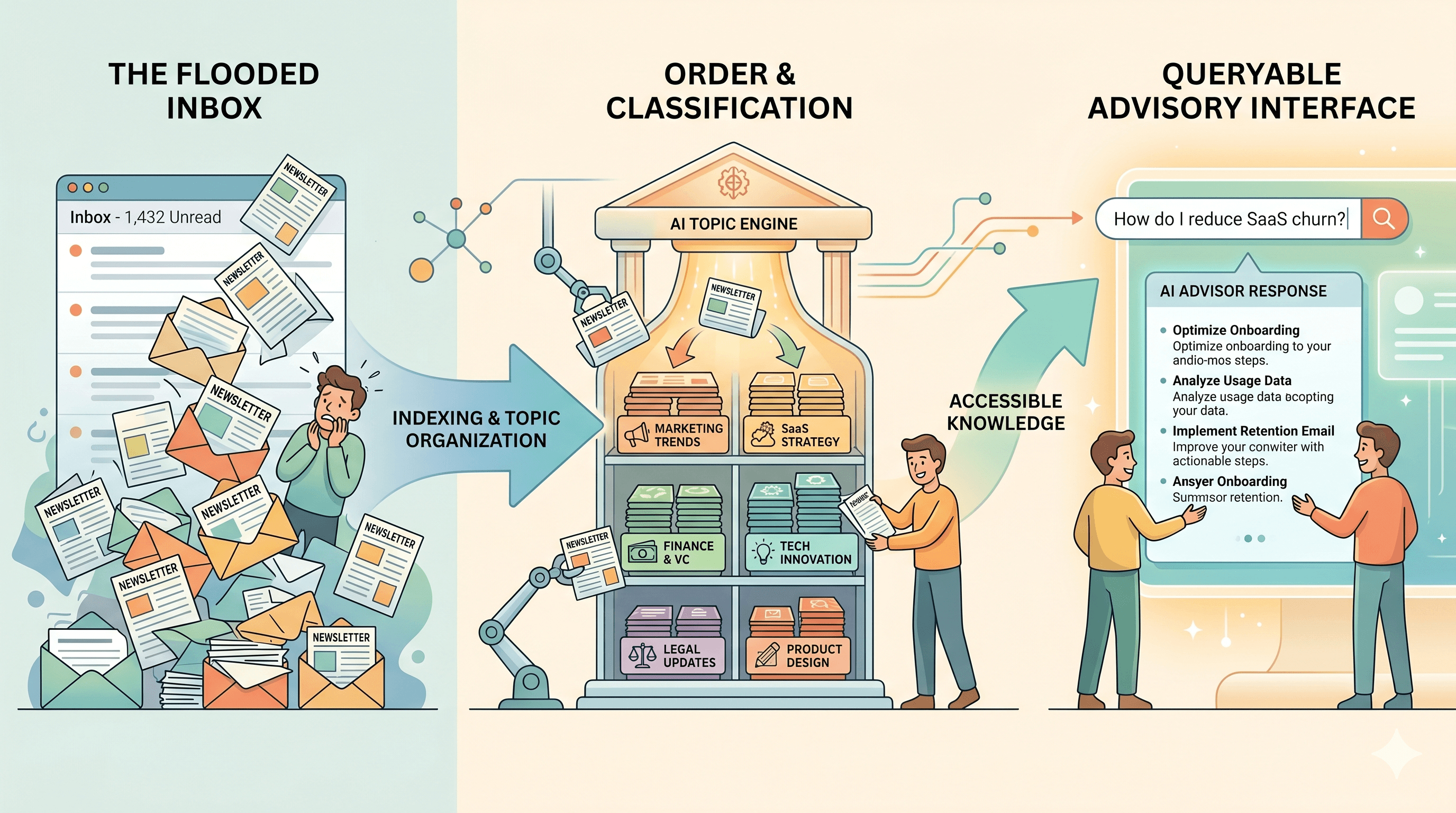
You can't search your newsletter archive by topic. You can't query it by question. You can't say "what have the people I follow said about customer churn?" and get back a synthesized answer. You can only try to find a specific issue you vaguely remember reading once, fail, and then google the question and find something worse.
The knowledge workers who get the most value from newsletters are the ones who have built elaborate manual systems for tagging, categorizing, and revisiting content. Good for them. But that's a full-time hobby on top of an already full day.
What it would look like if it actually worked.
Imagine every newsletter you subscribe to was instantly indexed, queryable by topic, and connected to your business context. Not an archive: an active knowledge base. Imagine asking "what do my expert sources say about hiring your first sales rep?" and getting a synthesized answer that draws on everything published in your subscriptions on that topic.
That's not a fantasy. That's what an AI advisory board built from your email subscriptions does.
The 80% of newsletters you're not reading? Indexed anyway. The 20% you are reading? Also indexed. The guilt loop ends because you don't need to read everything; your board is doing it for you.
Your subscriptions become an asset instead of a liability.
Keep Reading:
- 8 Best Ways to Organize Your Newsletter Subscriptions with AI: practical newsletter management
- How I Use My Daily Digest to Stay on Top of 30+ Newsletters: the daily digest approach
- The Information Overload Problem: why the consumption model is broken