Why Masterclass and Courses Don't Replace Real Advice (And What Does)
Why Masterclass and Courses Don't Replace Real Advice (And What Does)
I've spent more money on courses than I want to admit publicly. One of them had a module on "making decisions under uncertainty" that I found genuinely useful, right up until I needed to make an actual decision under actual uncertainty, at which point I couldn't remember a single thing from it.
This is the dirty secret of the online education industry. Frameworks are memorable in the context of a course. Applied to a real problem, six weeks later, with no one to help you connect the dots? They evaporate.
Passive learning is not the same as having an advisor.
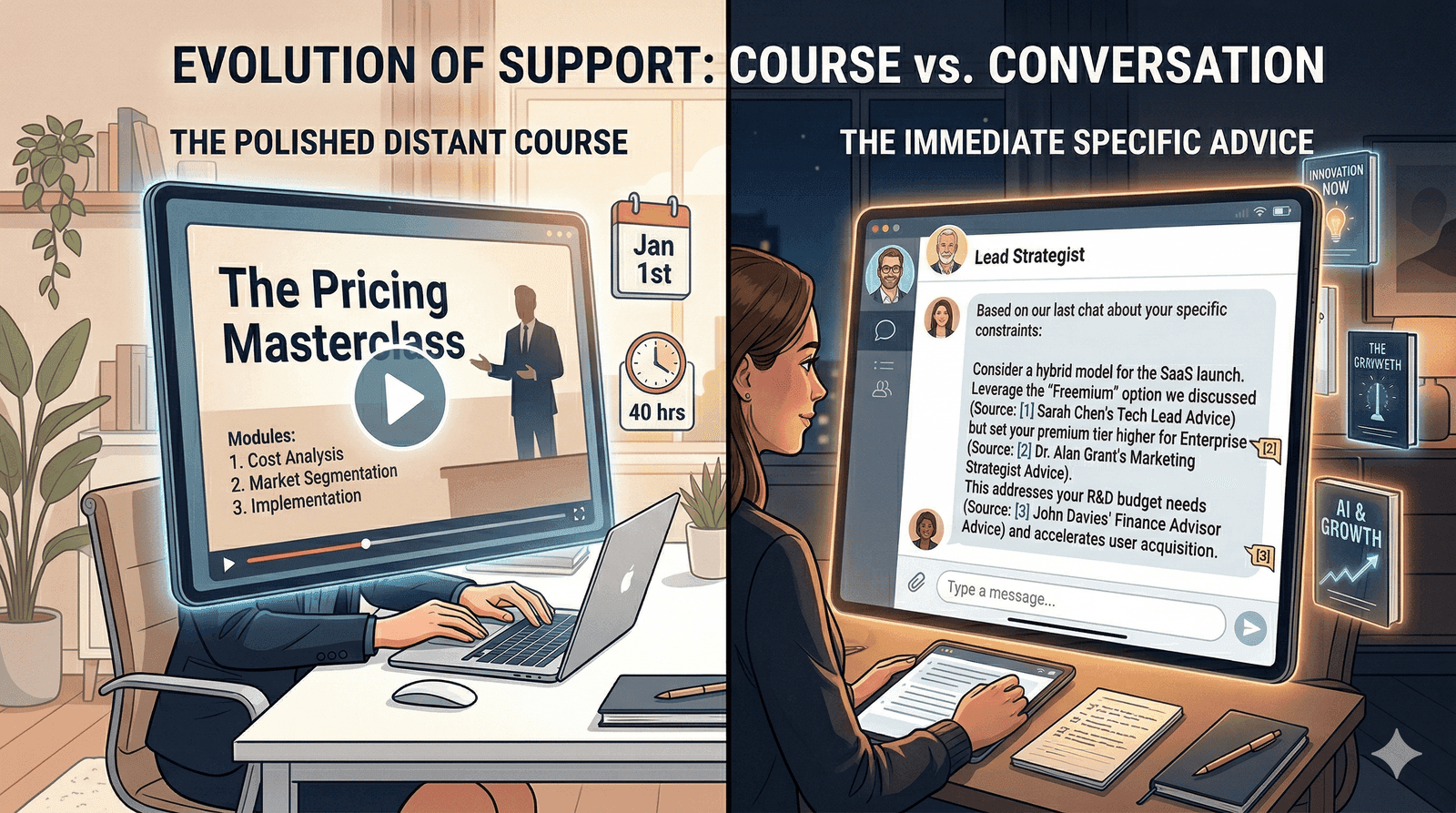
Masterclass teaches you what great people think. It does not help you figure out what you should do with that thinking. The distinction matters enormously.
When Gordon Ramsay teaches you knife technique, you learn knife technique. You don't get to pause the video and say, "actually, I have a gas stove and I'm working with frozen fish, how does this change things?" The course doesn't know your situation. It doesn't care. It's broadcasting to thousands of people simultaneously, and it works best for skills that transfer cleanly across contexts.
Business strategy is almost never that.
The decisions that actually matter (your pricing model, your hiring sequencing, your go-to-market timing, your pivot decision) are deeply contextual. They depend on your market, your team, your resources, your risk tolerance, your runway. A course teaches the principle. An advisor applies it.
The application layer is what's missing.
I've watched probably 40 hours of Hormozi content. I believe most of it. But when I'm staring at a decision about whether to change my pricing structure, what I need is not a re-watch of the relevant video. I need someone, or something, to say: "here's what Hormozi has said about this specific type of decision, here's how it applies to your situation, here's where I'd adjust based on your context."
That's the application layer. Courses don't have one. Your AI advisory board does.
When you build a board from the experts you already follow, you're not replacing their content. You're creating a way to interact with their thinking rather than just absorbing it. You move from student to practitioner, from consuming frameworks to deploying them against real decisions.
What courses are actually good for.
I don't want to throw courses under the bus entirely. They're great for building foundational knowledge: understanding a domain well enough to ask better questions, developing skills that transfer broadly, getting structured exposure to a new area. If you're new to SaaS metrics, a good course is a faster on-ramp than reading 200 blog posts.
But once you have the foundation? What you need is judgment. Context-aware, source-specific, situation-sensitive judgment. And that's not a thing a pre-recorded video can give you.
The best founders I know aren't the ones who took the most courses. They're the ones who surrounded themselves with the best advisors and asked good questions. The question is whether you have access to those advisors, and until recently, most people didn't.
Keep Reading:
- Why You Forget 90% of What You Read (And How AI Fixes It): the science behind course content evaporating
- The Case for AI-Powered Learning: how knowledge workers will learn in 2026
- How to Set Up Your First Adviserry panel in 5 Minutes: start applying expert frameworks to your decisions