I Used to Spend 12 Hours a Week on Content. Now 4 Minutes.
I Used to Spend 12 Hours a Week on Content. Now 4 Minutes.
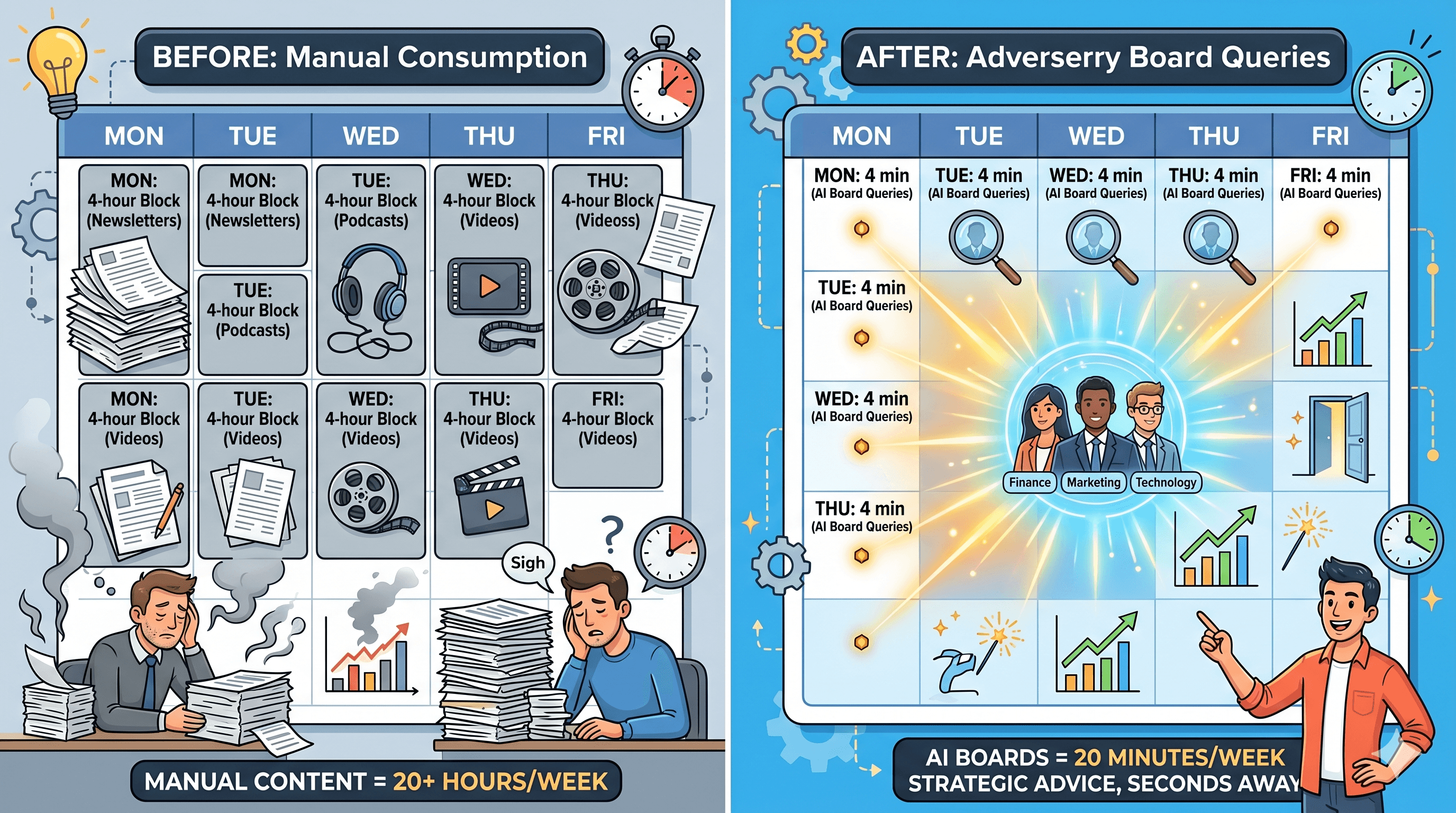
I tracked it once, out of morbid curiosity. In a given week, I was spending somewhere between ten and fifteen hours on what I'd generously call "strategic learning": reading newsletters, watching founder videos, listening to podcasts, skimming articles my co-founder forwarded me. Four hours. Per week. That's roughly 200 hours a year.
The uncomfortable question I eventually had to ask myself: how much of that was actually making me better at running my company?
The honest answer was somewhere around 15%.
The 85% problem.
The other 85% (roughly 170 hours a year) was content consumed and not meaningfully retained or applied. Not because it was bad content. Most of it was quite good. But information that's consumed passively, without a specific problem to attach it to, doesn't stick and doesn't translate into decisions.
I was spending 170 hours a year becoming vaguely more informed and no more effective.
The shift.
When I started using an AI advisory board built from my existing subscriptions, the relationship with content changed. I still subscribe to newsletters I trust. I still read occasionally, when an article catches my attention. But I don't feel the obligation to read everything. Because if I need to know what my expert sources think about a specific question, I can ask, and get the relevant synthesis back in seconds.
Those hours went away. They weren't replaced by something else. They were freed.
What I do with the other 3 hours and 56 minutes.
Build things. Talk to customers. Actually think, without inputs competing for the attention. Go for a walk without a podcast in my ears, which felt strange the first few times and now feels like the best part of my week.
The meta-irony here is that the best thinking I do happens when I'm not consuming information. Synthesis happens in the gaps. You can't synthesize if the gaps are always full.
Reducing my consumption didn't make me less informed. It made me better at using the information I already had, and gave me a way to retrieve specific information when I actually needed it, rather than hoping I'd absorbed it during one of those sessions.
200 hours a year is a meaningful asset if you're using it on the right things. Four minutes of querying when you have a real question is a lot more efficient than twelve hours of hoping something sticks.
Keep Reading:
- Why You Forget 90% of What You Read (And How AI Fixes It): the science behind passive consumption failure
- The Information Overload Problem: why subscribing to genius isn't enough
- How I Use My Daily Digest to Stay on Top of 30+ Newsletters: the 60-second alternative to reading everything