The Advice Gap: Why Middle-Market Founders Get the Worst Guidance
The Advice Gap: Why Middle-Market Founders Get the Worst Guidance
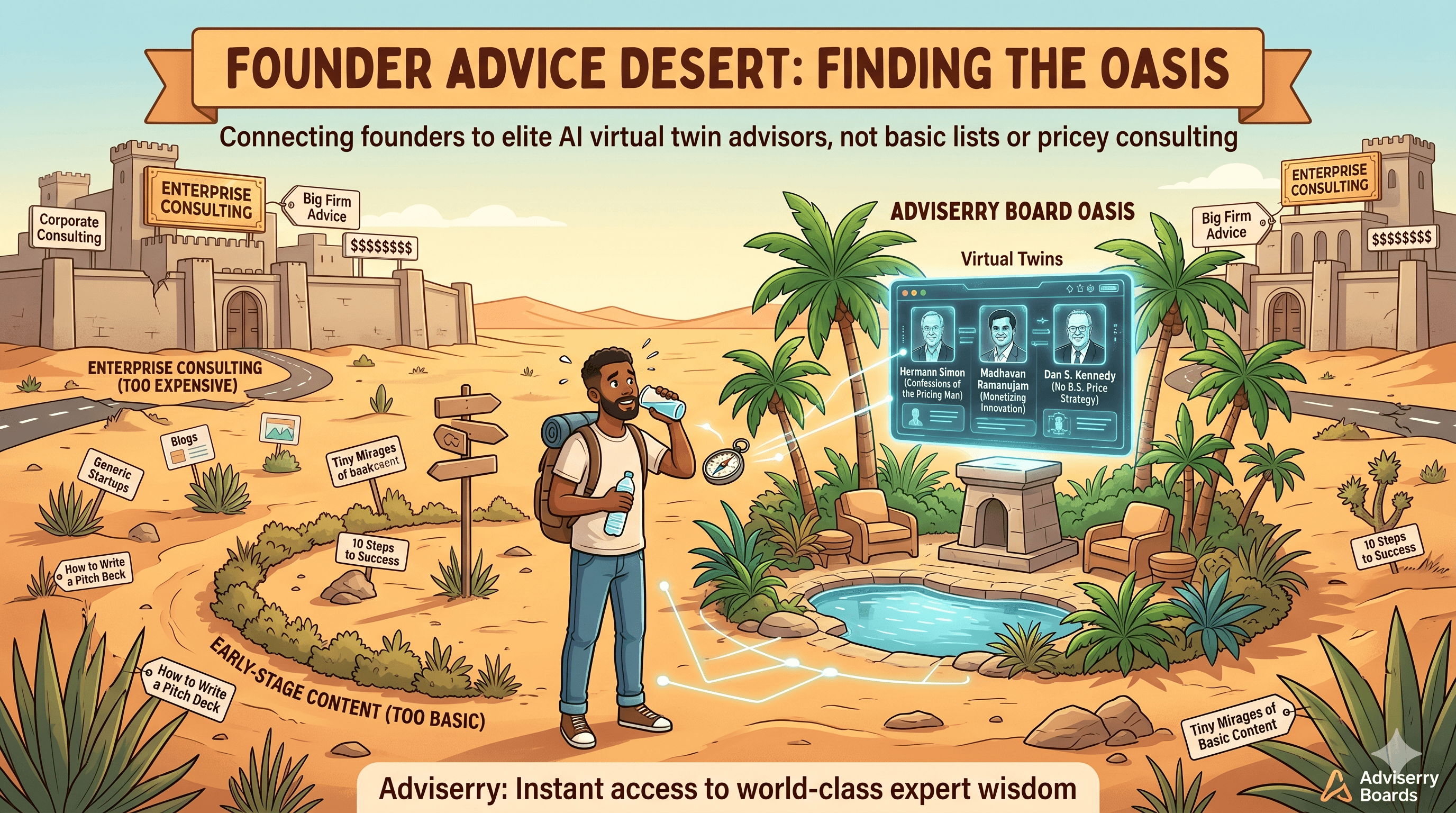
The early-stage founder ecosystem gets a lot of attention. Y Combinator, Techstars, accelerator programs, a thousand blog posts about finding product-market fit, countless podcasts targeted at pre-revenue builders. The advice is sometimes good, sometimes generic, but at least it exists and it's plentiful.
The enterprise-stage company has consultants, fractional executives, expensive coaches, and entire advisory firm structures designed to serve them. The advice is bespoke, priced accordingly, and generally quite good.
And then there's the middle. The $1M-$10M revenue company. The bootstrapped SaaS at $800K ARR. The productized service business generating $2.5M a year. The founder who's past the "am I going to make it?" phase but nowhere near the "should I hire McKinsey?" phase.
This is the most underserved group in the business advice market. By a significant margin.
Why the middle gets overlooked.
The advice market follows money. Pre-revenue founders are cheap to serve with content, so there's a lot of content. Enterprise clients have enormous budgets, so there are enormous advisory firms. The middle market has neither the volume of the early stage nor the budget of the enterprise.
A consultant worth their salt charges $500/hour. That's sustainable for a founder at $5M ARR with healthy margins. It's painful for a founder at $1M ARR who's taking home $120K and reinvesting the rest. Not impossible, but it forces a difficult prioritization calculation.
A top-tier business coach at $2,000-$3,000 a month is similarly positioned. Technically affordable. But when you're watching every dollar of operating expense with the intensity that $1M-$3M ARR founders typically do, a $36K annual coaching commitment is hard to justify against the alternative uses of that capital.
What middle-market founders actually need.
They don't need early-stage advice. They've figured out product-market fit. They're past the zero-to-one phase. What they need is strategic guidance on the operational and growth challenges specific to their stage: hiring the first sales leader, moving from founder-led sales, building repeatable processes, deciding when to raise vs. bootstrap, managing margin as they scale.
This is a specific skillset. It's not the same as seed-stage startup advice. It's not the same as McKinsey strategy. It's the zone where the playbooks are narrower, the stakes are higher than they were, and the specific expertise required is genuinely harder to find for free.
The case for AI advisory at this stage.
An AI advisory board built from the operators and investors who write specifically about this zone (the First Round Review, the Lenny Rachitskys of the world, the founders who've built and scaled through this exact stage) gives middle-market founders access to the precise expertise that the market has failed to serve.
Not a generic answer. Not a startup-phase framework that doesn't apply anymore. Not McKinsey pricing for problems a well-curated set of expert sources could solve for $24.99 a month.
The advice gap is real. It has a price, paid mostly in slower growth and more costly mistakes. And it's one of the more solvable problems in the founder ecosystem right now.
Keep Reading:
- Why Every Founder Needs a Personal Board of Advisors: closing the advice access gap
- How I Replaced My $5,000/Year Coaching Program: affordable alternative to premium coaching
- 10 Best Ways to Use AI as a Business Advisor: practical AI advisory for the middle market