The Case for AI-Powered Learning: How Knowledge Workers Will Study in 2026
The Case for AI-Powered Learning: How Knowledge Workers Will Study in 2026
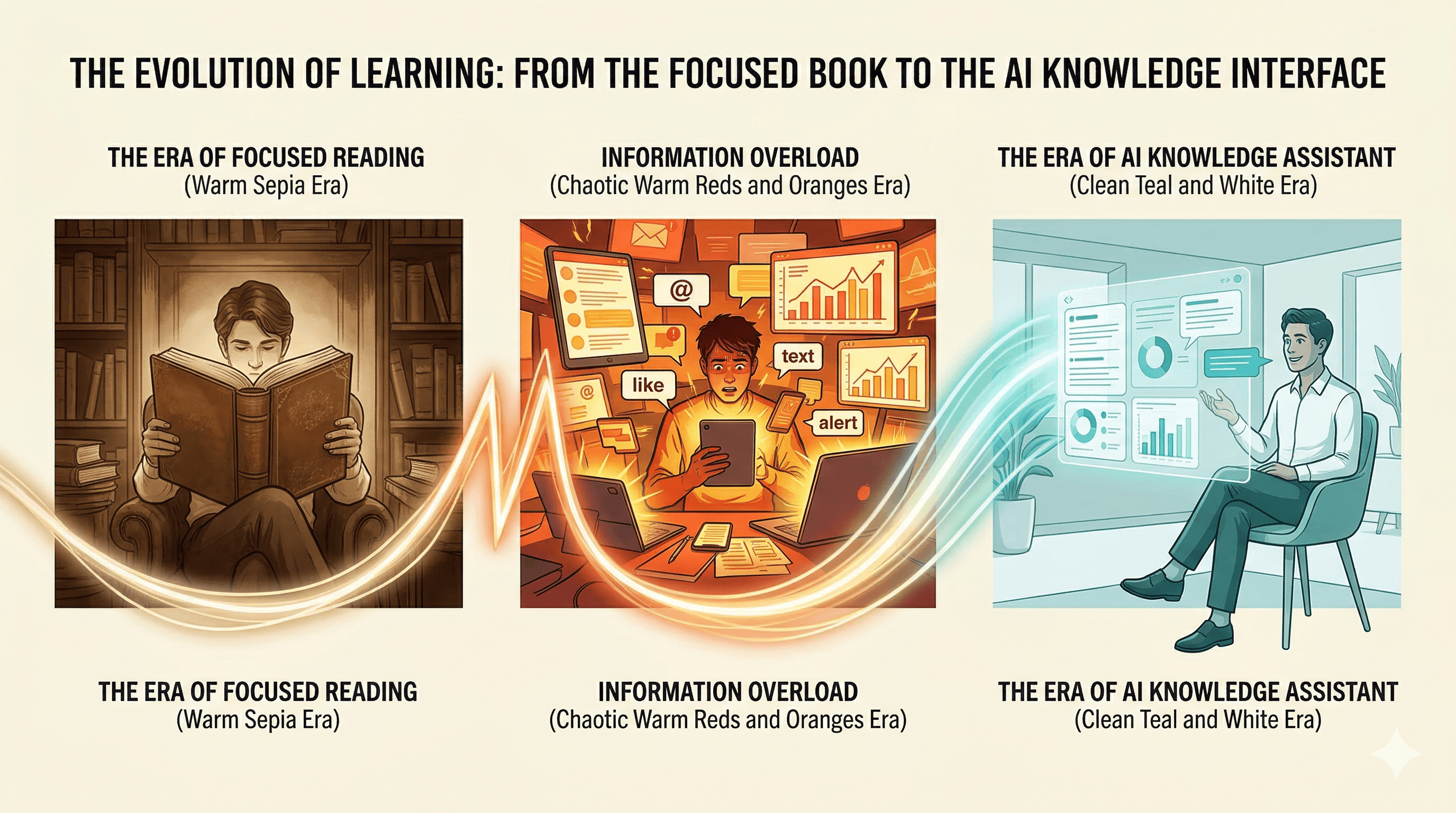
For the last 20 years, professional learning has looked roughly the same. Subscribe to content. Read (or skim) content. Forget content. Encounter a problem. Wish you could remember that article you read about it. Google the same thing again. Repeat forever.
That loop is finally breaking.
Not because we've gotten better at reading or remembering. We haven't. If anything, our attention spans are shorter and our content intake is higher, which makes the retention problem worse. The loop is breaking because AI is changing what "learning" even means for knowledge workers.
The old model: consume and hope to retain.
Read the book. Listen to the podcast. Watch the lecture. Take notes if you're disciplined. Hope the information sticks. Hope you can find it later when you need it.
This model has a known failure rate of 70-90% (thanks, forgetting curve). We've accepted this for so long that most people don't even think of it as a problem. It's just "how learning works." You read a lot, you remember some of it, and you try to read enough that the small percentage you retain is still useful.
For most of human history, that was the best we could do. But "the best we could do" and "good" are different things.
The new model: capture everything, query on demand.
The fundamental shift AI enables: stop trying to put knowledge into your brain, and start building systems where knowledge lives outside your brain but is instantly accessible.
This sounds obvious in hindsight. We already do this with facts (nobody memorizes phone numbers anymore, we just search for them). But we haven't applied the same thinking to expertise, advice, and frameworks, the kind of knowledge that actually drives business decisions.
When I can ask "What does Alex Hormozi recommend for pricing a new offer?" and get a cited answer in 10 seconds pulled from his actual content, I don't need to have memorized his pricing framework. I need to know the framework exists and that I can access it. The AI handles the storage and retrieval. My brain handles the application and judgment.
What this looks like in practice:
Your newsletter and podcast subscriptions get auto-ingested, summarized, and indexed. (This is what Adviserry does, which I built, and I'm biased about.)
When you face a decision, you query your knowledge base for relevant expert advice. Not generic internet advice. Advice from the specific experts you've chosen to learn from.
The AI synthesizes multiple perspectives and shows you where experts agree and disagree. You make better decisions because you're considering more viewpoints than your memory alone could provide.
Over time, your knowledge base compounds. Every new newsletter issue, every new video, adds to the depth and richness of answers you can get. You don't have to study more. You have to build a better library.
The three skills that matter in this model:
Curation becomes more important than consumption. Choosing who to follow matters more than how much you read. If your sources are high quality, your knowledge base is high quality. If you follow noise, you get noise back.
Asking good questions becomes the key learning skill. In the old model, the skill was reading comprehension. In the new model, it's query formulation. "What should I do about marketing?" gets a generic answer. "What do my sources recommend for content marketing strategy at the pre-PMF stage for a B2B SaaS tool?" gets a useful one.
Application replaces memorization. The value shifts from "knowing things" to "doing things with knowledge you can access." This favors practitioners over academics, operators over theorists, and people who take action over people who accumulate information.
This isn't about being lazy.
I can already hear the pushback: "So you just want AI to do your thinking for you?" No. I want AI to do my remembering for me so I can do better thinking.
There's a massive difference between outsourcing your judgment and outsourcing your memory. The first one is dangerous. The second one is just smart infrastructure.
Every executive with an assistant who prepares briefing documents before meetings is doing the same thing. They're not thinking less. They're thinking with better inputs. AI just makes that accessible to everyone, not just people with human assistants.
Where this is headed.
Right now we're in the early stages. Tools like Adviserry, Notebook LM, and Readwise are starting to close the gap between content consumption and knowledge access. But the model will keep improving.
Imagine: your AI knows every podcast you've listened to, every newsletter you've received, every book you've highlighted, every conversation you've had about your business. And it can draw on all of that context when you ask a question. That's not science fiction. Most of the pieces exist today. They just haven't been fully connected yet.
The founders and knowledge workers who build these systems now will have a compounding advantage over the next few years. Not because they're smarter, but because they've built better infrastructure for their thinking.
Start building yours. The knowledge is already flowing into your inbox. You just need a system that catches it.