The Democratization of Expert Advice: Why This Matters Beyond Business
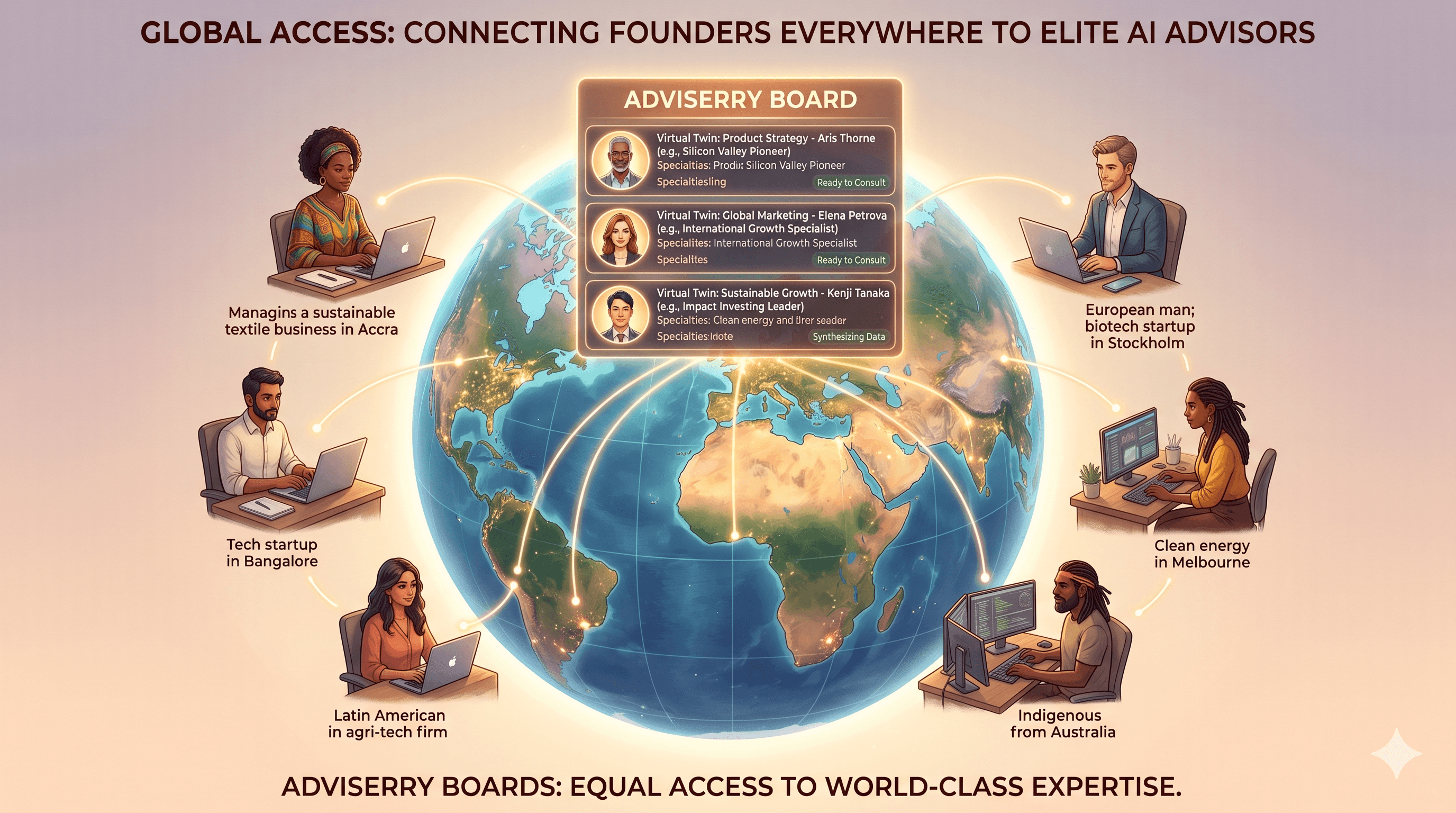
The Democratization of Expert Advice: Why This Matters Beyond Business
I want to make a larger point here, which is different from the "here's how to use our product" frame I usually write in. Stick with me.
Access to high-quality, personalized business advice has always been gated. Explicitly or implicitly, the best advice went to the people with the most resources, the strongest networks, and the most prestigious credentials. A founder with a Harvard MBA and a warm intro to a16z gets different advice than a bootstrapped founder in Lagos who's building the same product with the same intelligence.
That's not fair. It's also not just a business problem.
The compounding effect of advice access.
The advice you receive shapes the decisions you make. The decisions you make shape the trajectory of your business. The trajectory of your business shapes your financial outcomes, your team's livelihoods, the customers you serve, and, at scale, the economic development of the community around you.
Bad advice or no advice compounds over time, same as good advice does. The founder who doesn't know to test pricing assumptions before scaling sales, who doesn't understand retention mechanics, who doesn't have access to the frameworks that the better-advised founder does: that founder loses ground that's very hard to recover.
The advice gap is a compounding disadvantage.
What "democratization" actually looks like.
I'm wary of the word "democratization" in tech contexts. It gets used too loosely and sometimes to paper over the fact that the things being democratized still have barriers of their own: language, internet access, payment infrastructure.
But in the specific case of expert advisory: a founder in Lagos, in Manila, in Warsaw, in a mid-sized city in the American South that's nowhere near a startup hub, if they're connected to the internet and subscribe to the same expert newsletters as a YC founder, they can build the same advisory board. Same sources. Same synthesis. Same quality of strategic input.
That's a real thing. Not a marketing talking point.
The thing I think about.
I built Adviserry partly because I was frustrated by the advice access problem in my own career (not the extreme version, I'm aware of my privilege), but I know what it feels like to need strategic input and not have access to the kind of advisory relationship that would provide it.
The founders I want to serve most are the ones who are too far from the traditional hubs, too under-resourced for formal coaching, too new to have built the network that high-quality advice usually runs through.
They have the intelligence. They have the work ethic. They're building real things for real customers. They just don't have the same access to the thinking that could accelerate them.
If an AI advisory board helps close that gap even partially (not perfectly, not completely, but meaningfully), that seems worth working on.
Keep Reading:
- How to Set Up Your First Adviserry panel in 5 Minutes: get started regardless of where you are
- Why Every Founder Needs a Personal Board of Advisors: the case for accessible advisory
- 10 Best Ways to Use AI as a Business Advisor: practical ways to use AI for guidance