The Loneliest Job in the World: Why Every Solo Founder Needs an Advisory Board
The Loneliest Job in the World: Why Every Solo Founder Needs an Advisory Board
Nobody warns you about the loneliness.
The pitch decks, the startup mythology, the founder Twitter feeds: they're full of team photos and co-founder stories and launch parties. They're not full of the Monday mornings when you're staring at a problem you don't know how to solve, can't afford to hire for, and can't explain to anyone in your life who isn't living it.
I'm not dramatic enough to say that founding a company alone is the hardest thing in the world. It isn't. Plenty of things are harder. But it has a specific flavor of isolation that I hadn't anticipated and that took me longer to address than I'd like to admit.
The circle of trust problem.
When you're a solo founder, the people who know you best are usually the people who understand your business least. Your partner is supportive but has never thought about SaaS churn in their life. Your friends from before the startup think you're either going to be rich or need help. Your parents worry. Your old colleagues are doing the corporate thing and can't quite track what you're building.
The people who understand your business are usually the experts you follow from a distance: the newsletter writers, the podcast hosts, the founders who've written books or built in public. They understand the problems. They've solved adjacent ones. They could give you useful advice.
They just don't know you exist.
What an advisory board actually does for loneliness.
I'm not going to oversell this. An AI advisory board doesn't replace human connection. It doesn't give you the experience of someone who genuinely knows you, roots for you, and calls to check in. Those things matter, and if you're missing them, the right answer is other humans.
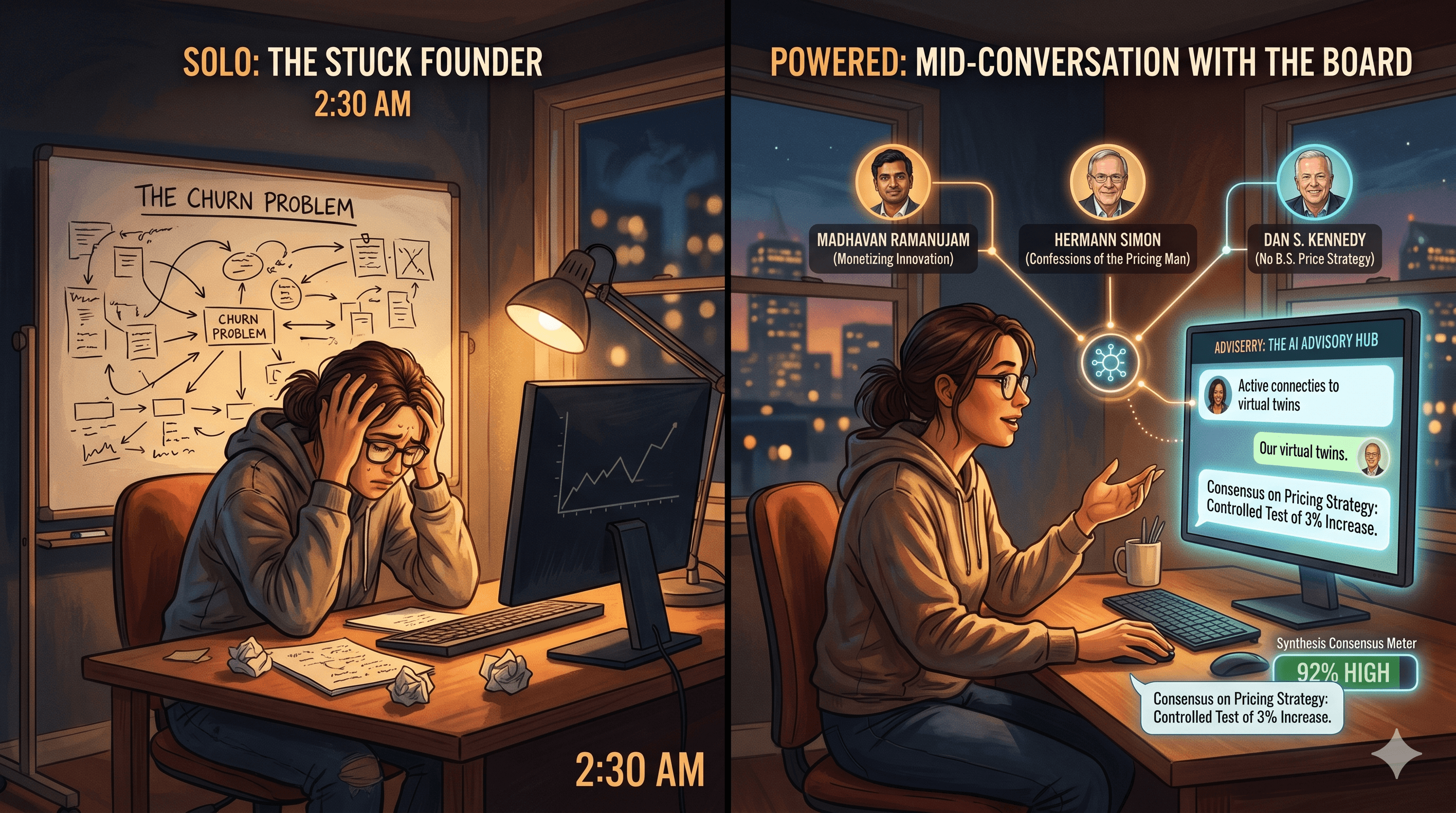
But it fills a specific gap that other humans mostly can't fill: the gap between the strategic questions you have and the strategic answers you can access. When you're stuck on a pricing decision at 11pm and the only person who'd understand the question is asleep on another coast, your advisory board is available.
More than the practical answers, there's something about the process itself. Writing down the question clearly. Getting back a considered response. Having a "conversation" about a hard problem that you can then bring to the decision point with more confidence than you started with.
It's not the same as a great mentor. But a great mentor wasn't an option for most of us.
The access thing, plainly stated.
Advisory boards in the traditional sense (the formal ones with equity and quarterly meetings) are for founders who already have networks. Who've made enough in a previous exit to be worth an advisor's time. Who can get warm intros to the people worth talking to.
That's not most founders. Certainly wasn't me for most of my early career. The expertise I needed existed. I just couldn't access it.
An AI advisory board built from the people you already follow is, at minimum, a version of access. Not perfect access. But real, usable, on-demand access to the thinking of people who've solved your problems before.
That's not nothing. For a solo founder at 11pm, it's actually quite a lot.
Keep Reading:
- Why Every Founder Needs a Personal Board of Advisors: turning distant experts into accessible advisors
- How I Replaced My $5,000/Year Coaching Program: from isolation to AI-powered guidance
- How to Build a "SaaS Founder" Advisory Board: build your advisory board this week