From Information Hoarder to Decision Maker: How AI Advisory Changed My Operating Speed
From Information Hoarder to Decision Maker: How AI Advisory Changed My Operating Speed
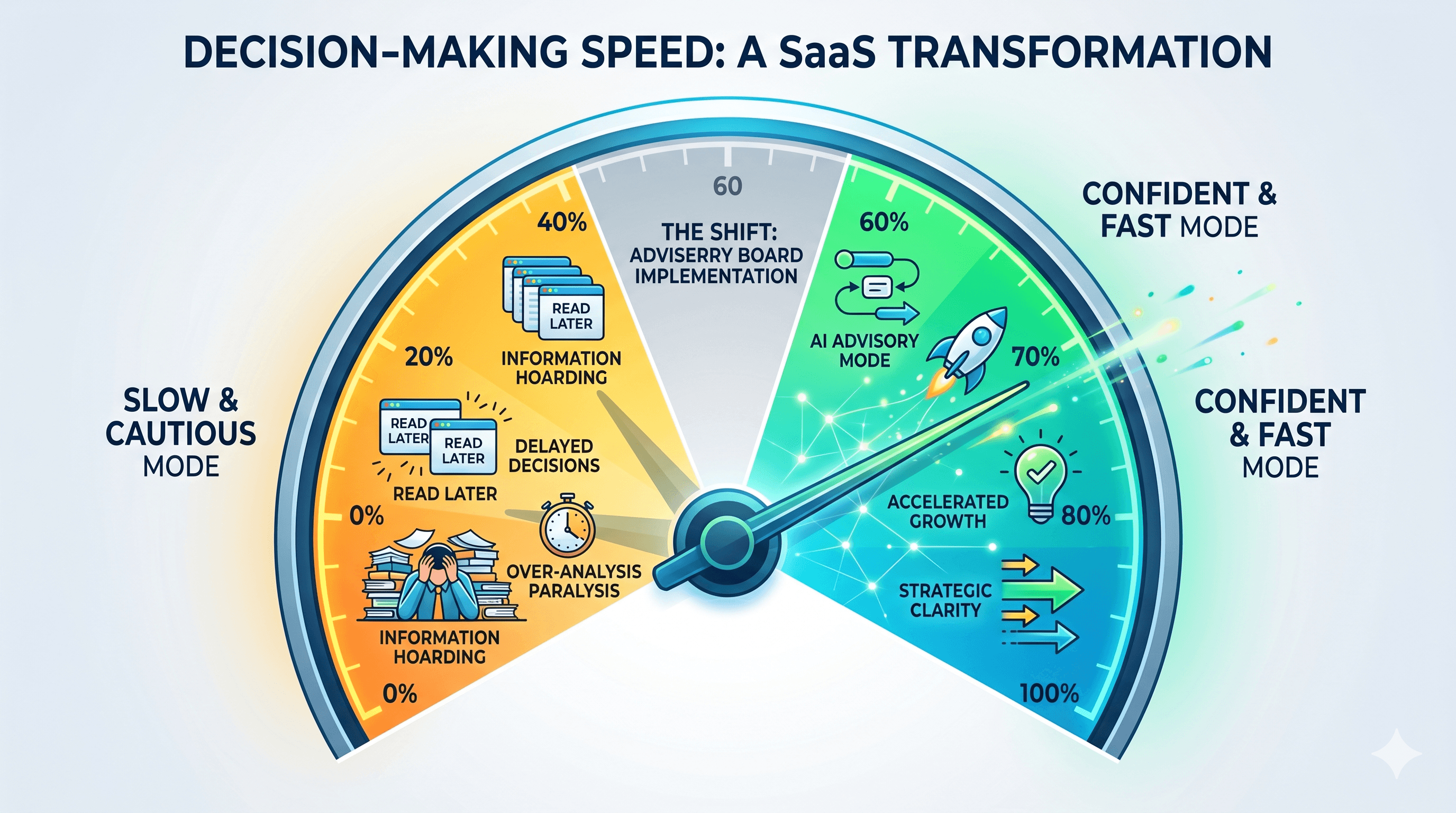
I am, by nature, a researcher. I don't love making decisions with incomplete information. I love making decisions with too much information, which is a different problem that sounds like thoroughness but is mostly just a sophisticated form of procrastination.
"I need to read more about this before I decide" is one of the most effective lies I've ever told myself. It sounds responsible. It's usually just fear of commitment dressed up in productivity clothing.
The consumption trap.
Most knowledge workers I know (particularly founders, particularly the ambitious ones) have some version of this pattern. Before we make a decision, we want to feel like we've done the research. We subscribe to more newsletters. We listen to more podcasts. We take notes and build systems for the notes and then read about better systems for taking notes.
At some point, the research becomes the thing instead of the preparation for the thing.
The specific trigger for me was realizing that I was consuming more content about the same topics I'd been consuming content about for years. I wasn't learning new things. I was reinforcing existing beliefs and calling it research. The incremental value of the 14th article about pricing strategy is approximately zero.
What changed when the information was already there.
When I built an AI advisory board from the expert sources I already followed, something shifted that I didn't expect. Not the information itself; I'd already been consuming it. The shift was in my relationship to the information.
Instead of consuming as a form of preparation, I started querying as a form of decision-making. I'd have a question. I'd ask it. I'd get back a synthesized answer from sources I trusted. I'd make the call.
The loop closed. The research became the answer rather than the prerequisite.
I'm still a researcher by nature. I still think carefully before deciding. But the bar for "I've done enough research" changed significantly. When I have a synthesized perspective from 10 expert sources I trust, I have enough. When I've read a few newsletters and feel like there might be more to learn. That's the trap. Those two things feel similar but they're not.
The operating speed thing.
The compounding effect of faster decisions is surprising until it happens to you. It's not that any one decision is dramatically faster. It's that over the course of a week, you've made a dozen calls you would previously have deferred, researched, or worried about. And the business moves correspondingly faster.
Speed of decision-making is one of the most undervalued competitive advantages in early-stage startups. You can iterate faster, test more, learn more, compound more. The founders who are stuck in perpetual research mode don't lose on the quality of their eventual decisions; they lose on the volume of their decisions over time.
Information hoarders turn into great learners. Decision makers turn into great operators.
Keep Reading:
- Why You Forget 90% of What You Read: why more consumption doesn't equal better decisions
- Second Brains Are Broken: why manual knowledge systems fail
- The Information Overload Problem: the broader subscription overload problem