How I Stopped Second-Guessing Every Decision (And Started Shipping)
How I Stopped Second-Guessing Every Decision (And Started Shipping)
Here's a thing I used to do: make a decision, feel okay about it, then immediately begin to wonder if I'd made the wrong one. Research more. Find a counterargument. Reconsider. Make the same decision again, but less confidently. Wait a few days. Make it again.
This is not a time management problem. It's a confidence problem. Specifically, a sourced confidence problem.
When you don't have access to expert-level input on a decision, you compensate with volume. You read more. You think more. You ask more people whose opinions you're not sure you trust. The goal is to build enough internal evidence that you feel okay moving forward. This works, poorly and slowly.
The second-guessing loop.
The founders I know who struggle most with shipping are almost never the ones who make bad first decisions. They're the ones who can't commit to first decisions. They've read enough to know that there's a counterargument to almost everything. They've been burned by moving too fast before. They've internalized "do your research" without having a clear definition of when research is done.
The loop is exhausting and it's slow. It consumes the kind of mental energy that could be going toward execution.
What changes when the answer is sourced.
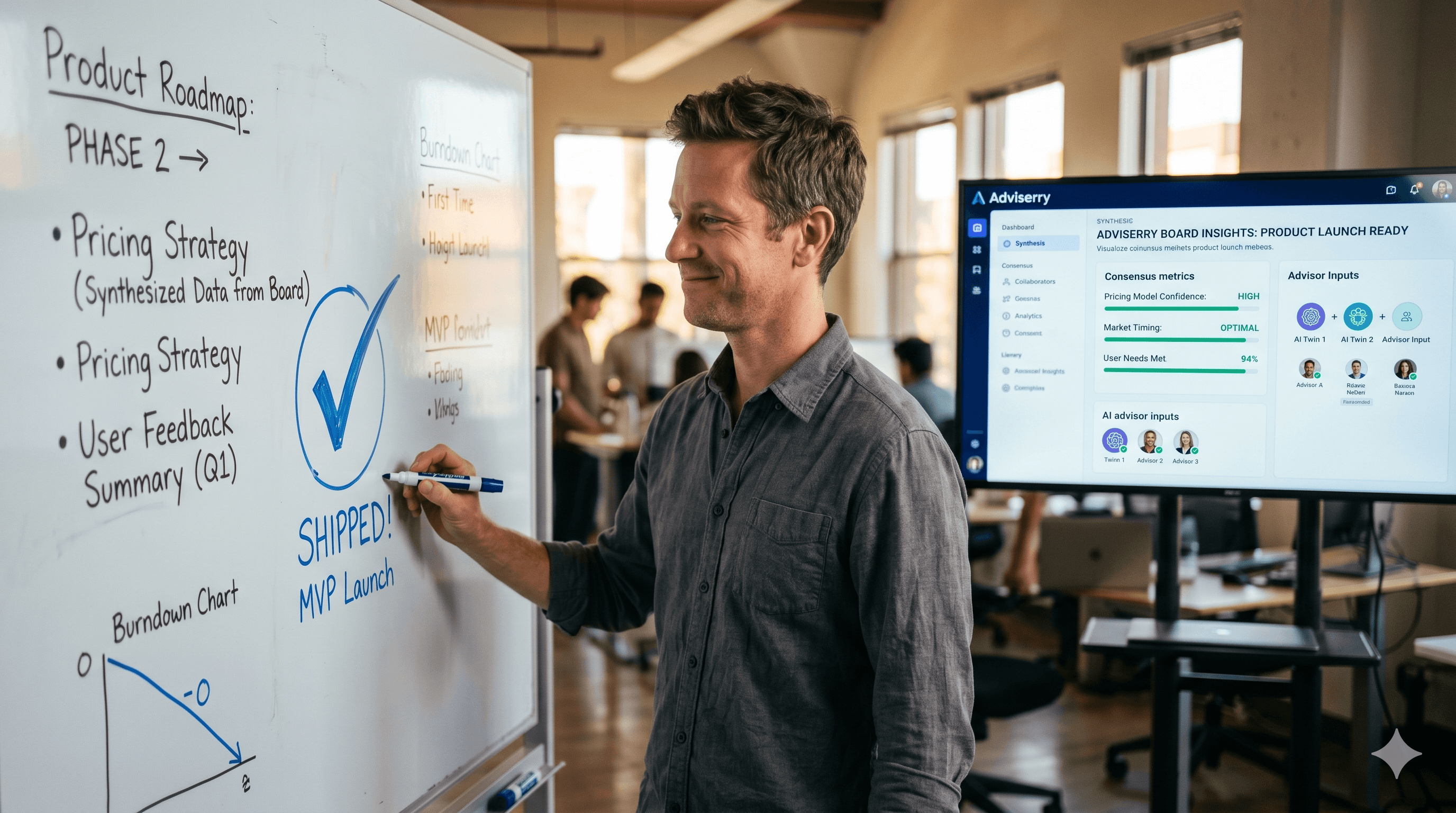
When I have a decision to make and I ask my advisory board (and the board comes back with a synthesized perspective from three sources I trust, with reasoning, with tradeoffs), something shifts. I'm not choosing between my gut and my anxiety anymore. I'm working with a framework that came from people who've solved this problem before.
I can still disagree with the framework. I can still decide differently. But I have something to push against, which is categorically different from having nothing.
The second-guessing doesn't disappear. But it has a different character. Instead of "did I even think about this correctly?", it's "I understand what the thinking says, and here's why I'm adjusting it for my context." That's a productive form of second-guessing. It leads somewhere.
The shipping thing.
Shipping velocity is one of those metrics that's hard to measure but easy to feel. When you're moving, you're learning. When you're stuck in the decision loop, you're not. The compounding advantage of higher shipping velocity over six or twelve months is significant: more tests, more data, more customer feedback, more iteration.
The founders I know who ship well aren't the ones who think less carefully. They're the ones who have better frameworks for knowing when they've thought enough. Expert-sourced input is a reliable way to reach "done thinking, time to move."
That's what it changed for me. Not the quality of any one decision. The speed at which I could commit to decisions and get moving.
Keep Reading:
- How to Cross-Reference Advice From Multiple Experts: the power of synthesized expert input
- Why You Forget 90% of What You Read: why gut instinct fails without retrieval
- How I Use Adviserry to Get Personalized Pricing Advice: a confident pricing decision in action