Upload Your Pitch Deck. Get Advice Like Your Board Saw It.
Upload Your Pitch Deck. Get Advice Like Your Board Saw It.
Before any real advisory board meeting, you'd send materials in advance. Your deck, your financials, a brief on what you're working through. The whole point is that advisors shouldn't be hearing about your business for the first time in the meeting. Context in advance means the time you spend together is spent on depth rather than setup.
The exact same principle applies to an AI advisory board, and most people skip this step.
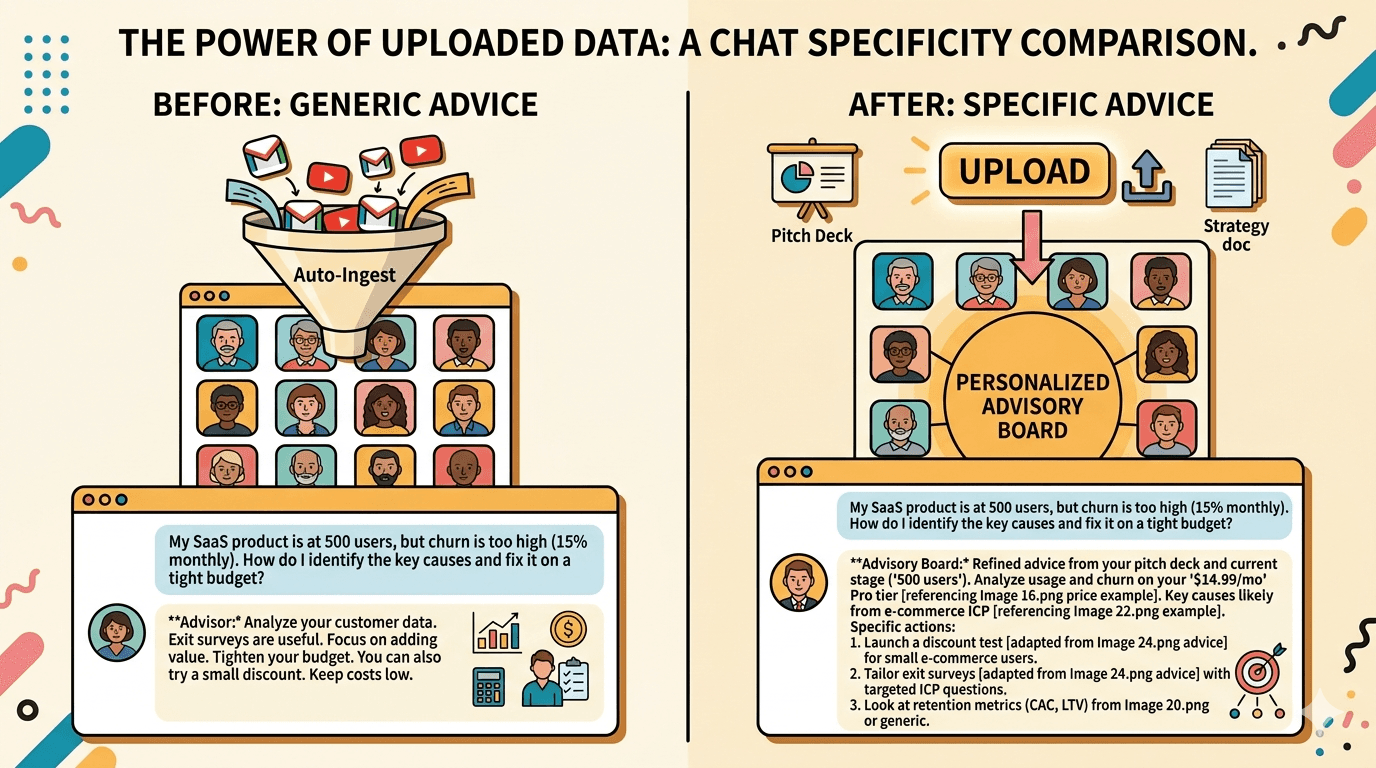
They connect their newsletters, they start asking questions, they get decent answers. But the answers are generic because the board doesn't know anything specific about their business. It's the difference between asking a smart generalist about your pricing and asking someone who's reviewed your full pricing history, your customer segments, and your current retention data.
What "upload your context" actually means.
You don't need to upload 50 documents. You need to give your board enough information to stop treating you like a stranger.
Start with your pitch deck, if you have one. Even an outdated one. It contains more useful context than you'd think: your market framing, your ICP, your competitive positioning, your growth story, your ask. A board that has read your deck knows your business in a way that no amount of asking questions from scratch can replicate.
Then add a brief strategy document, even if it's just a Google Doc with bullet points. What are you working on this quarter? What's your biggest challenge? What decisions are you trying to make? This doesn't have to be polished. It just has to be honest.
The quality change is immediate.
Every founder I've talked to who made the switch from "questions only" to "questions plus context documents" describes the same experience: the advice quality jumps immediately. Not marginally. Significantly.
Because the advice stops being about what founders generally should do and starts being about what you specifically should consider, given your stage, your ICP, your current constraints, and the specific question you're asking.
That's not a small thing. Advice that understands your situation is categorically different from advice that's applicable to a broad population.
Keep it updated.
The other habit worth building is updating your context documents when things change. Raised a round? Update your financials brief. Shifted your ICP? Update your customer profile. Changed your pricing model? Update your pricing doc.
Your board's usefulness is directly proportional to how current its context is. The founders who get the most value are the ones who treat the context upload as a living document rather than a one-time setup.
Your board saw your deck. Now it can give advice like it knows your business. Because it does.
Keep Reading:
- How to Set Up Your First Adviserry panel in 5 Minutes: the full setup guide
- How I Used Adviserry to Prepare for Investor Meetings: using your board with your pitch deck
- How to Build a "SaaS Founder" Advisory Board: build a board with full context