30 Days of Turning My Newsletters Into Weekly Actions
30 Days of Turning My Newsletters Into Weekly Actions
The setup takes a day. The part that decides whether this works is week two, when you stop asking better questions and start giving the system better context about what you are actually building. That is the whole lesson, and it took me a month to learn it.
I am not big on "30-day challenge" content. It usually reads like a sponsored product test paid for before anyone opened the box. I ran this one because I wanted to know whether treating my subscriptions as a working advisory panel would change how I operate, or just give me a nicer way to read email.
Day 1: setup
Connecting Gmail and picking sources took about twenty minutes. Grouping them into panels by the thing I was actually working on took longer, and it was the more important decision.
The instinct is to group by sender, or by broad topic. That is a filing system, and filing systems get abandoned. Grouping by the decision the sources inform is what makes the output useful later, because the panel is what the weekly actions get drafted against.
Backfill matters more than I expected. Connecting a newsletter brings its back catalogue, so by the end of day one there was something worth querying rather than an empty archive waiting for next Tuesday's send.
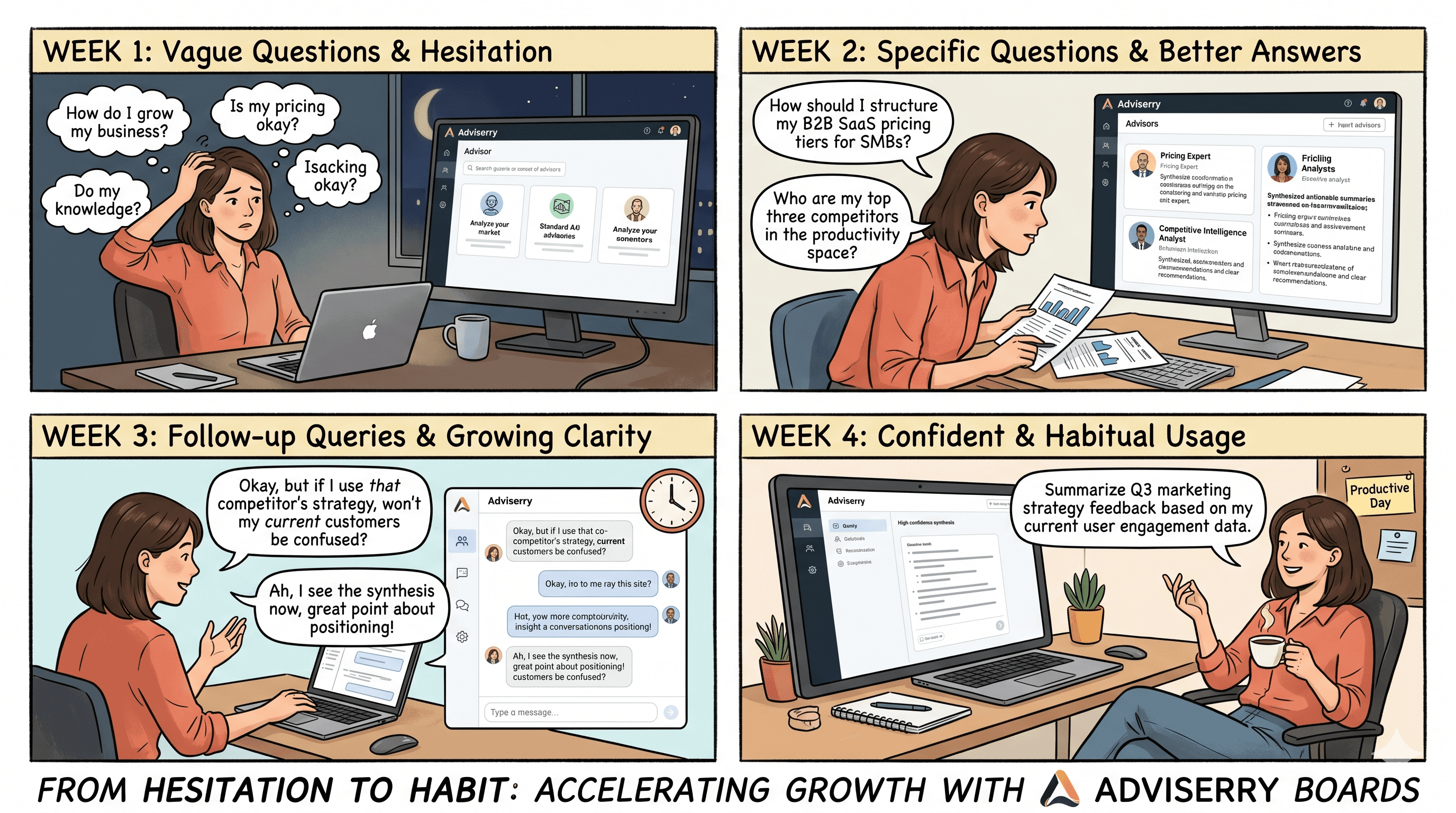
Week 1: unlearning search-engine mode
The first week was awkward, and the reason was entirely me.
I had been conditioned to treat AI tools as search engines. Type a keyword phrase, get results. Asking a genuinely strategic question in full sentences felt exposing, like admitting I did not already know something.
So my early questions were bad. I asked "how to grow faster", which is too broad to answer, and got back something appropriately vague. I asked about pricing and content strategy, which were specific enough, and got back something I could use.
Week 1 lesson: the output is only as good as the specificity of the input, and the habit you have to break is keyword thinking.
Week 2: context is the actual lever
This is the week that changed my mind about the whole category.
I had been trying to improve the answers by improving the questions. That works, but it caps out. The bigger lever was filling in the context profile: what I am building, who it is for, what I am stuck on this month, what I already tried and rejected.
Once that was in place, the drafted actions stopped being generically sensible and started being about my situation. Not "consider a pricing experiment", but a specific move against the constraint I had written down two weeks earlier, citing the source that suggested it.
The difference between a tool that answers questions and a tool that drafts actions is entirely in how much it knows about you. That sounds obvious written down. It was not obvious while I was doing it.
Week 2 lesson: improving context beats improving prompts, by a lot.
Week 3: the loop
By week three there was a rhythm. Read the drafted actions, keep the ones that fit, dismiss the ones that did not, and update the context when something changed.
The dismissals turned out to matter as much as the keeps. An action I dismissed was usually a sign that the system had a stale idea of what I was working on, which meant the context needed updating rather than the action being wrong in general.
Week 3 lesson: treat it as a loop you maintain, not an output you consume.
Week 4: what actually changed
The habit had formed by week four. The reflex to google a business question had mostly been replaced by the reflex to check what my own sources had already said about it.
The thing I noticed was not answer quality. It was decision speed. I was making calls faster, and not recklessly, because I had already seen what people I trust had said about the situation.
Week 4 lesson: when you trust the source, you trust the decision, and the deliberation time collapses.
The honest summary
Roughly 40 substantive queries over the month. About 35 were useful. Around 20 led to a decision or an action I would not have taken, or would have taken more slowly. Three produced frameworks I still use.
I did not transform anything in 30 days. What changed is how I get strategic input, and that compounds in a way a single good month does not.
If you run this yourself, the one thing I would do differently is spend day two on the context profile instead of discovering it in week two.
FAQ
How long does the setup actually take?
About twenty minutes to connect Gmail and pick sources, plus longer to group them well. Grouping by the decision a source informs, rather than by sender or topic, is the choice that determines whether the weekly actions are useful.
What is the most common mistake in the first week?
Treating it like a search engine. Keyword-style queries return shallow results because there is no keyword that expresses "should I raise prices given my churn". Full-sentence questions carrying your actual numbers work far better.
Why does the context profile matter more than the prompts?
Because a good prompt improves one answer, while good context improves every drafted action from then on. The gap between "generically sensible advice" and "a move against the constraint you wrote down last month" is almost entirely context.
Is 30 days long enough to judge it?
Long enough to know whether the habit sticks, not long enough to see compounding. The archive gets more useful the longer it runs, since the value is in retrieval across months of material rather than in any single week.
Keep reading: